
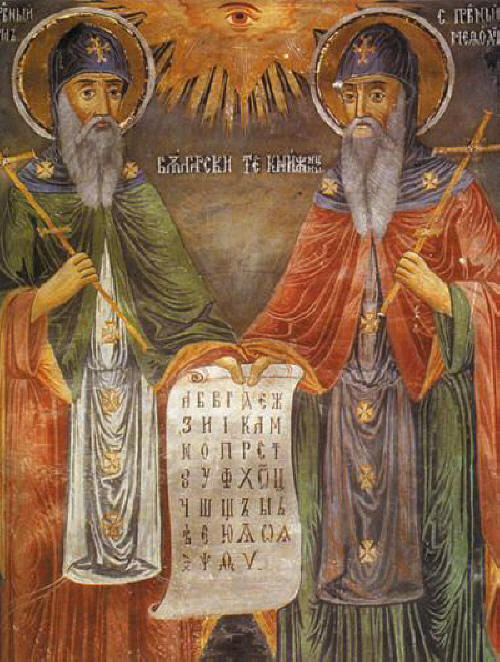
Saint Methodius
Bishop
- Remembered on
- February 14
- Life
- d. 885
- Born
- Thessalonica (Salonika)
About Saint Methodius
Methodius, the elder brother of Saint Cyril, was born in Thessalonica (Salonika); his baptismal name was probably Michael. Pope Saint John Paul II's encyclical Slavorum Apostoli places his birth between 815 and 820. Their father was a senior official of the imperial administration. Methodius rose to the rank of archon, or prefect, in a frontier province where many Slavs lived, but about 840 he left his career and entered a monastery at the foot of Mount Olympus in Bithynia, where his brother later joined him.
With Cyril he took part in a Byzantine delegation to the Khazars, and when Prince Rastislav of Greater Moravia asked Emperor Michael III for a teacher who could explain the faith to his people in their own language, the two brothers were chosen; probably by 863 they reached Greater Moravia, bringing the Scriptures and liturgical texts translated into Old Slavonic. About three years later they went to Rome, where Pope Hadrian II approved the Slavonic liturgical books. After Cyril died in Rome in 869, Methodius continued the mission alone.
He was consecrated archbishop for the territory of the ancient diocese of Pannonia, with the title of the see of Sirmium, and named papal legate for the Slavic peoples. Political and religious opposition led to his imprisonment for two years on the charge of invading another bishop's jurisdiction; he was freed through the personal intervention of Pope John VIII. Prince Svatopluk of Greater Moravia also opposed the Slavonic liturgy and raised doubts in Rome about his orthodoxy. In 880 Methodius went to Rome, was cleared of all accusations, and obtained from John VIII the bull Industriae tuae, which restored the prerogatives granted to the Slavonic liturgy by Hadrian II.
In his last years he devoted himself to further translations of the Scriptures, the liturgical books, works of the Fathers and the collection of Church and civil law called the Nomocanon, and he named his disciple Gorazd as his successor. He died on April 6, 885, and was buried in the cathedral of Velehrad. His disciples, expelled from the region, carried on the mission in Bulgaria, where the Cyrillic alphabet developed, and from there the faith spread to the Rus' of Kiev.
Why Saint Methodius matters
Pope Saint John Paul II wrote that Methodius is venerated with his brother as preacher of the Gospel and teacher "from God and the holy Apostle Peter," and as the foundation of full unity between the newly founded Churches and the more ancient ones. On December 31, 1980, in the apostolic letter Egregiae virtutis, he proclaimed Saints Cyril and Methodius co-patrons of Europe.
Patron saint of
Europe (Co-Patron) · ecumenism
Catholic Parishes with Related Names
Explore 20 parishes with related names. Find their Mass times, confession schedules, and adoration hours:
- Sts. Cyril and Methodius — Deer Park, NY
- Saints Cyril and Methodius Byzantine Catholic Church — Fort Pierce, FL
- SS Cyril and Methodius Parish — Milwaukee, WI
- Sts. Cyril and Methodius Catholic Church — Windber, PA
- Sts. Cyril and Methodius — Berwick, PA
- Sts. Cyril and Methodius — Clifton, NJ
- Sts. Cyril and Methodius Ukrainian Catholic Church — Olyphant, PA
- Saints Cyril and Methodius Catholic Church — Granger, TX
- Church of Sts. Cyril and Methodius — Binghamton, NY
- Ss. Cyril and Methodius — Sheboygan, WI
- Saints Cyril and Methodius — Wayland, MI
- Ss. Cyril & Methodius Catholic Church — Granger, TX
- Sts. Cyril and Methodius Parish — Windsor, ON
- Church of Sts. Cyril and Methodius — Cistern, TX
- Sts. Cyril and Methodius Catholic Church — Shiner, TX
- Saints Cyril and Methodius Byzantine Catholic Church — Spokane Valley, WA
- Saints Cyril & Methodius Parish — Corpus Christi, TX
- Sts. Cyril and Methodius Shrine — Dubina, TX
- Saints Cyril and Methodius Catholic Church — Slovak, AR
- SS. Cyril & Methodius — East Helena, MT
Sources