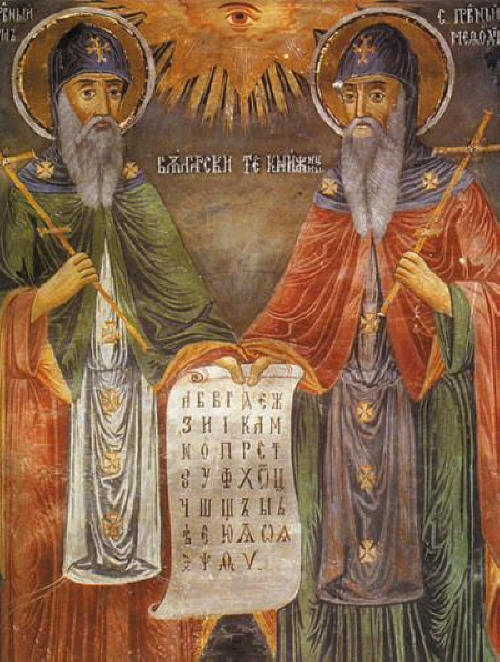
Saint Cyril
Monk
- Feast Day
- February 14
- Life
- 826–869
- Order
- Eastern monasticism
- Born
- Thessalonica, Byzantine Empire
Cyril was born Constantine in Thessalonica about 826, the youngest son of an imperial officer (drungarius) of the Byzantine theme of Thessalonica. With his elder brother Methodius he was the architect of the Slavic mission. Educated at the imperial court of Constantinople under Photius, the future patriarch, he was appointed librarian of Hagia Sophia and professor of philosophy, whence the epithet "the Philosopher."
About 860 he was sent on an embassy to the Khazars on the Volga. In 862 the prince Rastislav of Greater Moravia asked the Byzantine emperor Michael III for missionaries who could preach in the language of his people. The brothers were chosen. Before departing, Constantine devised the Glagolitic alphabet, the first script for a Slavic language, drawing on Greek minuscule and Eastern alphabets, and translated the Gospels and the necessary liturgical texts into the Old Slavonic vernacular.
The brothers reached Moravia in 863 and worked there four and a half years, training native clergy. Opposed by Frankish missionaries who held that the liturgy could be celebrated only in Hebrew, Greek, or Latin, the brothers traveled to Rome in 867 to present their work and translations to the Holy See. There Pope Adrian II approved the Slavonic liturgy and laid the translated books on the altar of Saint Mary Major.
Constantine fell ill at Rome and made his monastic profession with the new name Cyril. He died on February 14, 869, and was buried in the basilica of San Clemente, where his relics rest to this day. The General Roman Calendar of 1969 inscribed his memorial, joined to that of his brother Methodius, on February 14, the day of his death.
Pope Saint John Paul II's encyclical Slavorum Apostoli (1985) and his apostolic letter Egregiae virtutis of December 31, 1980, declared Cyril and Methodius Co-Patrons of Europe with Saint Benedict. Their work established the principle that the liturgy and Scriptures could be received in the language of the evangelized people, anticipating by more than a millennium the conciliar permission for vernacular liturgy. Their tomb at San Clemente has become a privileged place of Slavic pilgrimage to Rome.
Patronages
Europe (Co-Patron) · the Slavic peoples · ecumenism
Catholic Churches Named After Saint Cyril
20 parishes on Catholic Church Times share Saint Cyril's name. Find their Mass times, confession schedules, and adoration hours:
- Sts. Cyril and Methodius — Deer Park, NY
- Saints Cyril and Methodius Byzantine Catholic Church — Fort Pierce, FL
- Saints Cyril and Methodious Catholic Church — Clarkson, NE
- SS Cyril and Methodius Parish — Milwaukee, WI
- Sts. Cyril and Methodius Catholic Church — Windber, PA
- Sts. Cyril and Methodius — Berwick, PA
- Sts. Cyril and Methodius — Clifton, NJ
- Sts. Cyril and Methodius Ukrainian Catholic Church — Olyphant, PA
- Saints Cyril and Methodius Catholic Church — Youngstown, OH
- Saints Cyril and Methodius Catholic Church — Granger, TX
- St. Cyril Parish — Wilsonville, OR
- St. Cyril Catholic Church — Bannister, MI
- Saints Cyril and Methodius Byzantine Catholic Church — Girard, PA
- Church of Sts. Cyril and Methodius — Binghamton, NY
- St. Lawrence O'Toole-St. Cyril — Oakland, CA
- Church of St. Cyril — New York City, NY
- Church of St. Cyril of Alexandria — East Lansdowne, PA
- Kostol sv. Cyrila a Metoda — Slovenské Nové Mesto
- Kostol sv. Cyrila a Metoda — Poltár
- Kostol sv. Cyrila a Metoda — Mýtna
Sources