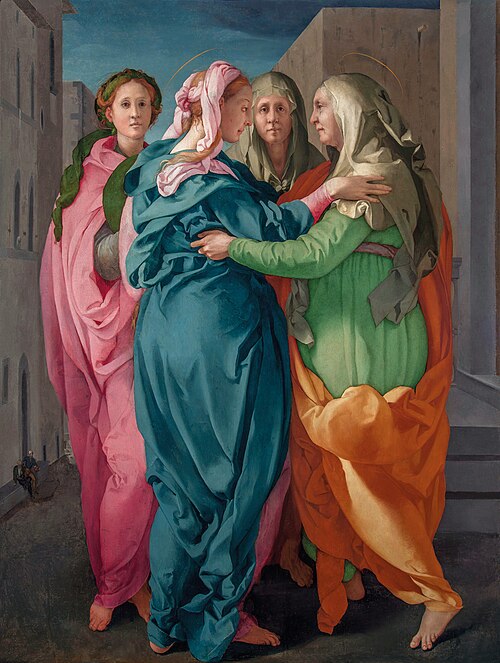
The Visitation of the Blessed Virgin Mary
Feast
- Feast Day
- May 31
The Feast of the Visitation of the Blessed Virgin Mary commemorates Mary's journey, soon after the Annunciation, to the hill country of Judah to visit her kinswoman Elizabeth, then in the sixth month of her pregnancy with John the Baptist (Luke 1:39-56). At Mary's greeting the child leapt in Elizabeth's womb, Elizabeth proclaimed the salutation Blessed are you among women, and blessed is the fruit of your womb, and Mary responded with the canticle Magnificat anima mea Dominum.
The feast originated in the medieval West and was extended to the universal Latin Church by Pope Urban VI in 1389. It was kept on July 2 in the older Roman Calendar; the post-Vatican II reform moved it to May 31 so that it falls between the Annunciation (March 25) and the Nativity of Saint John the Baptist (June 24), preserving the chronology of the Lukan narrative. In years when May 31 is impeded by a Sunday Solemnity, as in 2026 by the Solemnity of the Most Holy Trinity, the Feast of the Visitation yields to the Sunday and is not transferred (Universal Norms on the Liturgical Year, no. 60).
The Visitation is the second of the Joyful Mysteries of the Rosary. It is the first apostolic journey: Mary, bearing Christ within her, brings him to Elizabeth and to John, who is sanctified in his mother's womb. The Magnificat (Luke 1:46-55) is sung every evening at Vespers throughout the Latin Rite, the Church's daily renewal of Mary's praise.
Catholic Churches Named After The Visitation of the Blessed Virgin Mary
20 parishes on Catholic Church Times share The Visitation of the Blessed Virgin Mary's name. Find their Mass times, confession schedules, and adoration hours:
- Our Lady of the Visitation Parish - St. Mary of the Hills — Milton, MA
- Mary of the Visitation — Big Lake, MN
- Mary of the Visitation — Becker, MN
- St. Mary of the Visitation — Lockhart, TX
- Church of the Visitation Catholic Church — Norfolk, NY
- Church of the Visitation of the Blessed Virgin Mary — Alexander, IL
- Monastery of the Visitation of Holy Mary — Tyringham, MA
- Monastery of the Visitation — Toledo, OH
- Church of the Visitation of the Blessed Virgin Mary — Verboort, OR
- Shrine of the Visitation–St. Ann — St. Louis, MO
- Our Lady of the Visitation, Taperoo — Taperoo, SA
- Our Lady of the Visitation Parish — Luna, ISABELA
- National Shrine of Our Lady of the Visitation — Gamu, ISABELA
- The Visitation — Taynuilt, Scotland
- Our Lady of the Visitation — La Loche, SK
- Our Lady of the Visitation Catholic Church — Kiowa, CO
- Church of the Visitation — Camanche, IA
- St. Mary of the Visitation Parish — Cambridge, ON
- Church of the Visitation, Ballyhahill — Ballyhahill, Munster
- St Mary of the Visitation Church, Killybegs — Killybegs, Ulster
Sources