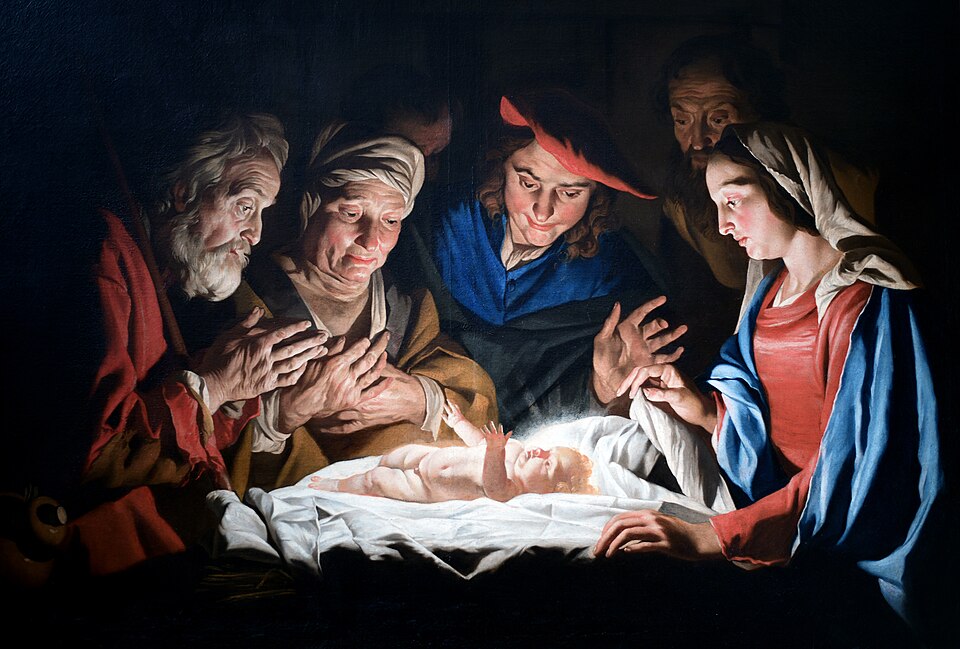
The Nativity of the Lord (Christmas)
Solemnity, Holy Day of Obligation
- Feast Day
- December 25
The Solemnity of the Nativity of the Lord celebrates the birth in time of the eternal Son of God, the Word made flesh. The date of December 25 is documented in the Latin West by the Chronograph of 354, which lists December 25 as the natalis Christi, and is firmly established by the late fourth century in both Rome (under Pope Saint Damasus I) and the Christian East (in most regions; the Armenian Church retains the older common celebration of Nativity and Epiphany on January 6). Two ancient explanations of the date are given: the so-called calculation hypothesis, which dates the Annunciation to March 25 (the spring equinox under the Julian calendar, also identified as the date of the Crucifixion) and the Nativity nine months later; and the influence of the Roman feast of Sol Invictus on December 25, against which Christians proclaimed Christ as the true Sun of Righteousness, sol iustitiae (Malachi 4:2).
The Roman Missal provides four distinct Mass formularies for the Solemnity: the Vigil Mass on the evening of December 24; the Mass during the Night (popularly called Midnight Mass); the Mass at Dawn; and the Mass during the Day. The Gospel readings traverse the mystery from the announcement of the angel and the birth at Bethlehem (Luke 2 at the Vigil, Night, and Dawn Masses) to the Prologue of John (1:1-18), proclaimed at the Mass during the Day, in which the Church confesses the eternal divinity of the Word who is now incarnate. December 25 is a Holy Day of Obligation throughout the Latin Church and begins the Octave of Christmas, which closes on January 1, the Solemnity of Mary, Mother of God. Christmas Time, in the reformed calendar, extends from First Vespers of Christmas to the Sunday after the Epiphany, the Feast of the Baptism of the Lord.
Christmas is the celebration of the central Christian dogma: the eternal God has truly assumed a human nature, body and soul, and has been born of the Virgin Mary at a definite hour, in a definite place, under the rule of definite men. Saint Athanasius's classical formula captures the meaning: God became man so that man might become God - that is, share in the divine life by grace.
From The Nativity of the Lord (Christmas)
"And the Word became flesh and made his dwelling among us, and we saw his glory, the glory as of the Father's only Son, full of grace and truth."
Catholic Churches Named After The Nativity of the Lord (Christmas)
20 parishes on Catholic Church Times share The Nativity of the Lord (Christmas)'s name. Find their Mass times, confession schedules, and adoration hours:
- The Nativity of the Blessed Virgin Mary, Roman Catholic Church — Belgique, MO
- Immaculate Conception -Church of the Nativity Parish — Pompey, NY
- Church of the Nativity — St. Marys, AK
- Church of the Nativity — Brandon, FL
- Church of the Nativity of Our Lord — Wayne, WV
- Church of the Nativity of the Blessed Virgin Mary — Nada, TX
- Church of the Nativity at St. Joseph — LaFayette, NY
- Church of the Nativity — Timonium, MD
- Chapel of the Nativity — Linlithgo, NY
- Church of the Nativity of the Blessed Virgin Mary-Cestohowa — Falls City, TX
- Chapel of the Nativity of the Blessed Virgin Mary — Quezon City
- Our Lady of the Nativity — Las Navas, NORTHERN SAMAR
- Our Lady of the Nativity, Hamley Bridge — Hamley Bridge, SA
- Church of the Nativity — Lutherville, MD
- Church of the Nativity (Prince of Peace Parish) — Bethlehem, CT
- The Church of the Nativity at St. Leo's Catholic Church — Tully, NY
- Church of the Nativity — Midland Park, NJ
- Catholic Church of the Nativity — Bartlett, TN
- St. Mary's of the Nativity Catholic Church — Nassau, NY
- St. Mary of the Nativity — Marshall, WI
Sources