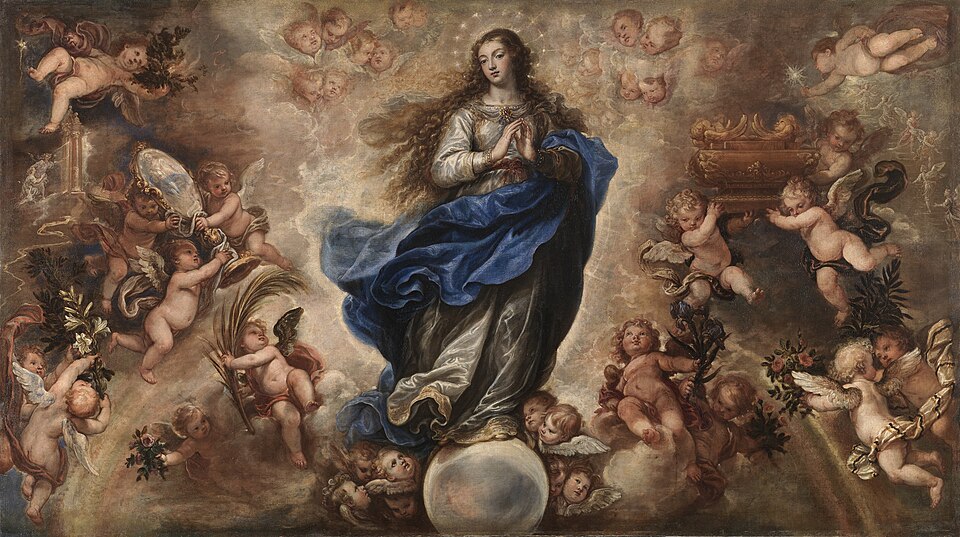
The Immaculate Conception of the Blessed Virgin Mary
Solemnity, Holy Day of Obligation, Patronal Feastday of the United States
- Feast Day
- December 8
The Solemnity of the Immaculate Conception celebrates the Catholic dogma that the Blessed Virgin Mary, in the first instant of her conception in the womb of her mother Saint Anne, was preserved free from all stain of original sin by a singular grace of Almighty God, in view of the foreseen merits of Jesus Christ the Savior. This was the constant faith of the Church East and West from the early centuries: the feast of Mary's Conception was being observed in the East by the seventh century and in the Latin West (initially in England and Normandy) by the eleventh. After medieval debates between the Franciscan and Dominican schools - resolved gradually in favor of the Franciscan position championed by Blessed John Duns Scotus - Pope Sixtus IV approved the feast for the universal Church in 1476.
The dogma was solemnly defined ex cathedra by Blessed Pope Pius IX in the apostolic constitution Ineffabilis Deus, issued on December 8, 1854, after consultation with the world's bishops in 1849. The definitive formula declares that the doctrine that the Blessed Virgin Mary, in the first instant of her conception, by a singular grace and privilege of Almighty God, in view of the merits of Jesus Christ, Savior of the human race, was preserved free from all stain of original sin, is a doctrine revealed by God, and therefore to be firmly and constantly believed by all the faithful. Four years later, in 1858, the Blessed Virgin appeared at Lourdes to Saint Bernadette Soubirous, identifying herself with the words I am the Immaculate Conception. The Sixth Provincial Council of Baltimore in 1846 had already chosen the Blessed Virgin Mary under the title of the Immaculate Conception as the Patroness of the United States, a choice ratified by Pope Pius IX. The basilica named for her in Washington, D.C. is the largest Catholic church in North America. December 8 is a Holy Day of Obligation in the United States.
The Immaculate Conception is not chiefly about Mary's privilege but about the Redemption: Mary was preserved from original sin in view of the merits of her Son, the Redeemer; she is the first and most perfect fruit of his Cross. Her freedom from sin from the first instant of her existence is the pattern of what every baptized Christian becomes by grace and what the redeemed humanity will fully be in the resurrection.
Patronages
the United States of America · the universal Church · the Diocese of Rome (since Pius IX)
From The Immaculate Conception of the Blessed Virgin Mary
"We declare, pronounce and define that the doctrine which holds that the most Blessed Virgin Mary, in the first instant of her conception, by a singular grace and privilege of Almighty God, in view of the merits of Jesus Christ, Savior of the human race, was preserved free from all stain of original sin, is a doctrine revealed by God and therefore to be firmly and constantly believed by all the faithful."
Catholic Churches Named After The Immaculate Conception of the Blessed Virgin Mary
20 parishes on Catholic Church Times share The Immaculate Conception of the Blessed Virgin Mary's name. Find their Mass times, confession schedules, and adoration hours:
- St. Mary of the Immaculate Conception — Fredericksburg, VA
- St. Mary's Cathedral of the Immaculate Conception — Portland, OR
- St. Mary of the Immaculate Conception — Monroe, MI
- Chapel of the Immaculate Conception — South Orange, NJ
- Our Lady of the Immaculate Conception (Bread of Life Parish) — Dayton, OH
- Monastery of the Immaculate Conception — Ellisville, MO
- St. Mary Of The Immaculate Conception — Rock Island, IL
- Church of the Immaculate Conception — Kalskag, AK
- Church of the Immaculate Conception — San Diego, CA
- St. Mary of the Immaculate Conception Parish — Jersey City, NJ
- St. Mary of the Immaculate Conception Parish — Avon, OH
- Mary of the Immaculate Conception — Rockville, MN
- Basilica of the Immaculate Conception — Conception, MO
- St. Mary of the Immaculate Conception — Muskegon, MI
- St. Mary of the Immaculate Conception — La Porte, TX
- Our Lady Queen of the Apostles Parish - St. Mary The Immaculate Conception Church — Derby, CT
- Our Lady of the Immaculate Conception of Aparaceda Parish — Bethel, CT
- Ukrainian Catholic Archeparchial Cathedral of the Immaculate Conception — Philadelphia, PA
- Chapel of the Immaculate Conception of the Blessed Virgin Mary — Williamsburg, WV
- Church of the Immaculate Conception — Fulda, OH
Sources