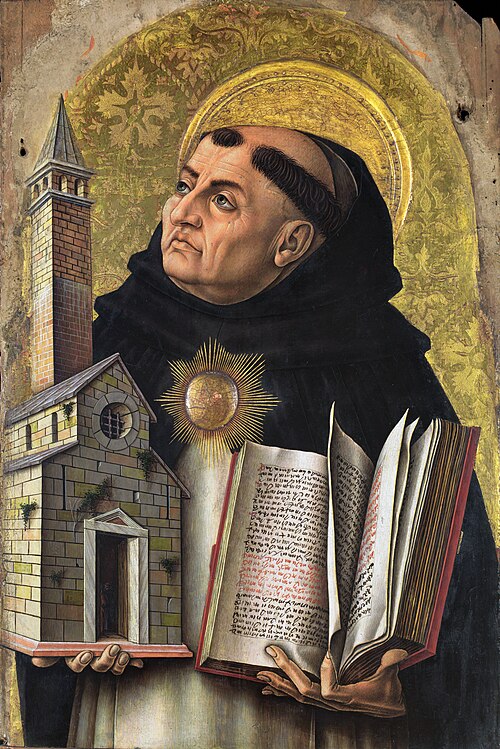
Saint Thomas Aquinas
Priest and Doctor of the Church
- Feast Day
- January 28
- Life
- 1225–1274
- Canonized
- 1323
- Doctor of the Church
- 1567
- Order
- Order of Preachers (Dominicans, OP)
- Born
- Roccasecca, Kingdom of Sicily
Thomas was born about 1225 at the family castle of Roccasecca, near Aquino in the Kingdom of Sicily, the youngest son of Landulf of Aquino and Theodora of Theate. From age five he was an oblate at the Benedictine abbey of Monte Cassino, and from 1239 he studied at the imperial University of Naples, where he encountered the works of Aristotle in their newly available Latin translations.
About 1244 he entered the Order of Preachers in Naples. His family, opposed to the choice, detained him for nearly a year at Roccasecca; after his release he was sent north to Paris and then to Cologne, where he was the pupil of Saint Albert the Great. He was ordained priest about 1250 and incepted as Master of the Sacred Page at the University of Paris in 1256.
His teaching career alternated between Paris (1256-1259, 1268-1272), the papal studium in Italy (1259-1268, at Orvieto, Rome, and Viterbo), and Naples (1272-1273). His major works include the Scriptum super libros Sententiarum, the Summa contra Gentiles (composed at the request, according to Dominican tradition, of Saint Raymond of Penyafort for the missions of Spain and North Africa), the Eucharistic office and hymns Pange lingua, Lauda Sion, Adoro te devote, and Verbum supernum prodiens for Corpus Christi at the request of Pope Urban IV in 1264, and above all the Summa Theologiae, his unfinished synthesis of Christian doctrine.
On December 6, 1273, after experiencing what he described to his secretary Reginald of Piperno as a vision during Mass, he ceased writing. Summoned by Gregory X to the Second Council of Lyon, he died on the way at the Cistercian abbey of Fossanova on March 7, 1274. He was canonized by Pope John XXII at Avignon on July 18, 1323. Pius V declared him a Doctor of the Universal Church in 1567 in the bull Mirabilis Deus, and Leo XIII renewed his patronage of Catholic schools and the foundational role of his theology in the encyclical Aeterni Patris (1879).
Leo XIII in Aeterni Patris taught that Aquinas, "clearly distinguishing, as is fitting, reason from faith, while happily associating the one with the other, both preserved the rights and had regard for the dignity of each." The Council of Trent placed his Summa on the altar beside the Scriptures and the decrees of the popes during its sessions. His Eucharistic hymns remain in the Roman liturgy of Corpus Christi. Pope Saint Paul VI's apostolic letter Lumen Ecclesiae (1974), on the seventh centenary of his death, again proposed him to the Church as the common Doctor.
Patronages
theologians · philosophers · students · Catholic universities · Catholic schools
Catholic Churches Named After Saint Thomas Aquinas
20 parishes on Catholic Church Times share Saint Thomas Aquinas's name. Find their Mass times, confession schedules, and adoration hours:
- St. Thomas Aquinas Catholic Church — Philadelphia, PA
- St. Thomas Aquinas — Bronx, NY
- St. Thomas Aquinas — Elkhart Lake, WI
- St. Thomas Aquinas Catholic Church — Saint Cloud, FL
- St. Thomas Aquinas — Bridgewater, MA
- St. Thomas Aquinas Catholic Church — Indianola, IA
- St Thomas Aquinas Catholic Church — Freeport, IL
- St. Thomas Aquinas Roman Catholic Church — Chicago, IL
- St. Thomas Aquinas Catholic Church — Webster City, IA
- St. Thomas Aquinas Catholic Newman Center (WKU) — Bowling Green, KY
- St. Thomas Aquinas Catholic Church — Sugar Land, TX
- St. Thomas Aquinas — Monterey Park, CA
- St. Thomas Aquinas — Derry, NH
- St. Thomas Aquinas — Croydon, PA
- St. Thomas Aquinas — Viera, FL
- St. Thomas Aquinas — Mount Pulaski, IL
- St. Thomas Aquinas — California, PA
- St. Thomas Aquinas — Dover-Foxcroft, ME
- Holy Family - St. Thomas Aquinas — Brooklyn, NY
- St. Thomas Aquinas (Flatlands) — Brooklyn, NY
Sources