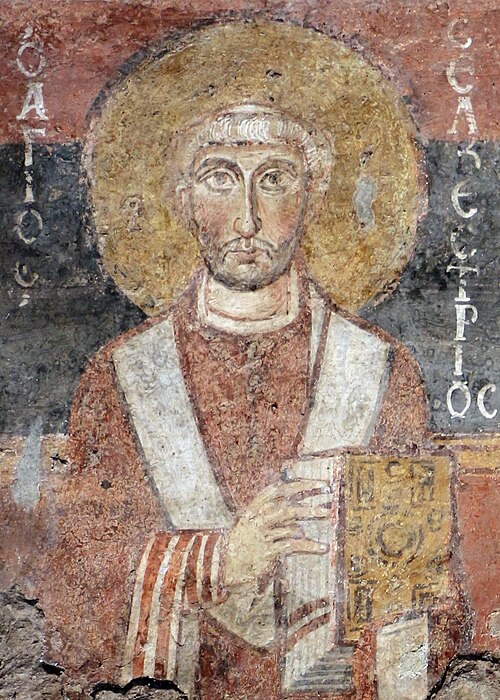
Saint Sylvester I
Pope
- Feast Day
- December 31
- Life
- d. 335
- Born
- Rome
Sylvester I was elected Bishop of Rome on January 31, 314, the year after the Edict of Milan ended the persecution of Christians and inaugurated the Constantinian peace of the Church. He served as Pope for over twenty-one years until his death on December 31, 335, the longest pontificate to that date and longer than every subsequent one until the nineteenth century.
His pontificate spans the dramatic transition of the Church from a persecuted minority to a publicly tolerated and increasingly favored body, but the historical record of Sylvester's personal role in that transition is unfortunately thin: he did not personally attend the First Council of Nicaea (325), the most consequential council of the era, but was represented by two priests, Vito and Vincent, who signed its decrees on his behalf and at whose hands the Council's anti-Arian Creed reached Rome and the West. His pontificate saw the construction of the Constantinian basilicas of Rome - Saint John Lateran (the cathedral church of the Diocese of Rome), Saint Peter on the Vatican, and the basilica over the tomb of Saint Agnes on the Via Nomentana. The legendary account in the apocryphal Donation of Constantine (an eighth-century forgery) makes Sylvester baptize and heal the emperor and receive from him sovereignty over the Western empire; modern historians regard this as wholly fictitious. He was buried in the Cemetery of Priscilla on the Via Salaria. His feast on December 31 is for many Catholic countries the New Year's Eve patronal celebration: in Germany, Switzerland, and Austria the night is still called Silvester.
Sylvester I is the patron of the post-persecution Church and of the year's end. His pontificate witnessed the building of the public Roman Church on the foundations of the catacomb Church, a transition fraught with new dangers as well as new opportunities, and one whose lessons the Church continues to ponder.
Sources