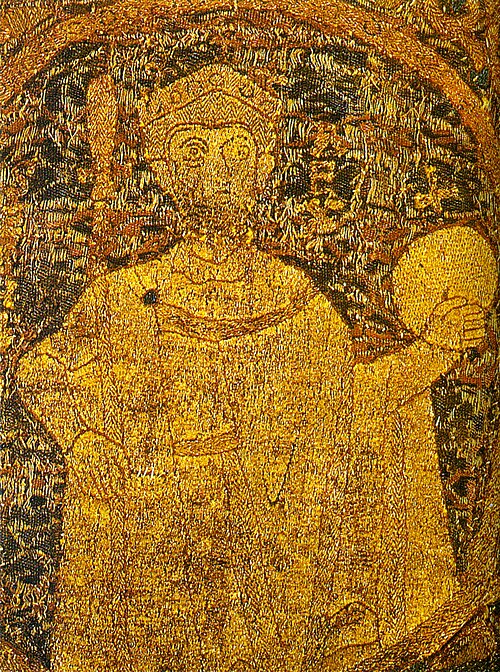
Saint Stephen of Hungary
King
- Feast Day
- August 16
- Life
- 975–1038
- Canonized
- 1083
- Born
- Esztergom, Principality of Hungary
Saint Stephen, originally named Vajk, was born at Esztergom about 975, son of Geza, Grand Prince of the Hungarians, and his Christian wife Sarolt. Around 985 the family was baptized and the boy received the name Istvan (Stephen) after the Protomartyr. He was educated by the Bohemian missionary bishop Saint Adalbert of Prague, who is traditionally said to have baptized and confirmed him. About 996 he married Gisela, sister of the future Emperor Saint Henry II.
On his father's death in 997 Stephen succeeded as Grand Prince and put down the pagan revolt of his cousin Koppany, taking the suppression as occasion for the Christianization of Hungary. He requested a royal crown and the right of independent ecclesiastical organization from Pope Sylvester II. The crown sent by the Pope (the Holy Crown of Saint Stephen, the regalia of the Hungarian state, preserved in the Parliament Building in Budapest) was used to crown Stephen on Christmas Day, 1000 (or January 1, 1001), as first Christian King of Hungary.
Stephen organized the Hungarian Church into ten dioceses, with Esztergom as the metropolitan see (still the primatial see of Hungary), founded numerous Benedictine monasteries (notably Pannonhalma), and codified the laws of the kingdom in a Latin code that protected the Christian faith and the institution of the family. He defeated the Bulgarian khan, the German Emperor Conrad II's army (1030), and several pagan chieftains in defense of the Christian kingdom. His son and heir, the prince Saint Emeric, predeceased him in a hunting accident in 1031, plunging the king into a long mourning. Before his death he formally placed the crown of Hungary under the patronage of the Blessed Virgin Mary, since which Hungary has been called the Regnum Marianum (Marian kingdom).
He died at Szekesfehervar on August 15, 1038, and was buried in the basilica of the Assumption that he himself had built. Pope Saint Gregory VII canonized him together with his son Saint Emeric on August 20, 1083, and August 20 is the principal Hungarian national feast and the date of the Memorial in Hungary. The General Roman Calendar observes the Memorial on August 16, leaving August 15 for the Solemnity of the Assumption (the day of his death).
Saint Stephen is the founder of Christian Hungary and the type of the Catholic Christian sovereign of the early Middle Ages. The Holy Crown of Saint Stephen is at once a relic and a constitutional symbol; under Hungarian medieval doctrine the crown itself, as a sacred object, holds the kingdom and confers legitimacy on the king. Pope Saint John Paul II, on his visits to Hungary in 1991 and 1996, repeatedly invoked Stephen as the founding model of Christian Hungary and Christian Europe.
Patronages
Hungary · kings · stonemasons · the death of children
Catholic Churches Named After Saint Stephen of Hungary
20 parishes on Catholic Church Times share Saint Stephen of Hungary's name. Find their Mass times, confession schedules, and adoration hours:
- St. Patrick-Catholic Community of St. Stephen-St. Patrick — Whitney Point, NY
- Mary, Mother of Martyrs Parish-St. Stephen — Des Plaines, IL
- St. Stephen's Catholic Church — Oak Creek, WI
- St. Stephen the Martyr Catholic Church — Maurepas, LA
- St. Stephen the Martyr Mission — Waterboro, ME
- St. Stephen the Martyr — Omaha, NE
- St. Stephen — East Grand Rapids, MI
- St. Stephen — Honolulu, HI
- St. Stephen Maronite Catholic Church — Charlotte, NC
- St. Stephen, Deacon and Martyr — Tinley Park, IL
- St. Stephen — San Francisco, CA
- St. Stephen — Richardton, ND
- St. Stephen — Grand Island, NY
- St. Stephen — Hagaman, NY
- St. Stephen Martyr Catholic Church — Merrillville, IN
- Holy Trinity-St. Stephen Parish — Fulton, NY
- Holy Trinity-St. Stephen Parish — Phoenix, NY
- Spirit of St. Stephen's Catholic Community — Minneapolis, MN
- St. Stephen Catholic Church — Cadiz, KY
- St. Stephen | San Esteban — Minneapolis, MN
Sources