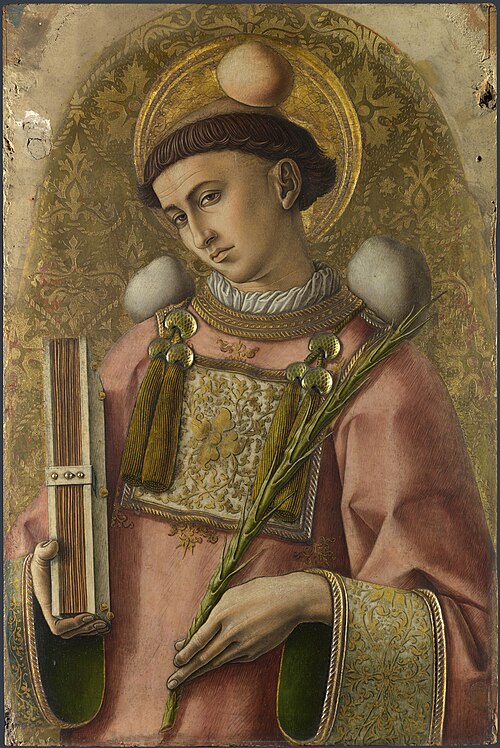
Saint Stephen
First Martyr (Feast)
- Feast Day
- December 26
- Life
- d. 36
- Born
- uncertain (a Hellenistic Jewish background)
Stephen, called the Protomartyr (the first martyr) of the Church, is the chief subject of Acts 6 and 7. He was one of the seven men full of the Spirit and of wisdom whom the apostles, in response to a complaint from the Hellenist (Greek-speaking Jewish) Christians of Jerusalem that their widows were being neglected in the daily distribution, set apart by prayer and the laying on of hands - the action universally identified by Catholic tradition as the institution of the diaconate. Stephen worked great wonders and signs among the people and engaged in disputation with members of the Synagogue of the Freedmen, who, unable to refute him, suborned witnesses to accuse him of speaking against the Temple and the Law (Acts 6:11-14).
Brought before the Sanhedrin, Stephen delivered the speech that occupies all of Acts 7: a sweeping rehearsal of Israel's history showing that God's saving action consistently broke out beyond the bounds of land and Temple, climaxing in the indictment of his hearers as the betrayers and murderers of the Just One. As they raged, Stephen, full of the Holy Spirit, looked up to heaven and saw the glory of God and Jesus standing at the right hand of God (Acts 7:55). They cast him out of the city and stoned him; the Pharisee Saul of Tarsus is named as consenting to his execution and guarding the cloaks of the executioners. Stephen's last words echo Christ's own from the cross: Lord, do not hold this sin against them (Acts 7:60). His martyrdom is dated traditionally to about AD 34-36. His placement on the day after Christmas is ancient: he is the first of the comites Christi (companions of Christ) of the Christmas Octave - the first martyr who follows the newborn King by the witness of his blood.
Stephen is the model of the deacon: ordained for service of the poor and yet a powerful preacher of the Word; full of the Holy Spirit; faithful unto death; and praying, like his Lord, for those who killed him. Saint Augustine taught that Saul was eventually given to the Church through Stephen's intercession - making Stephen, in a sense, the spiritual father of the Apostle of the Gentiles.
Patronages
deacons · stonemasons · the dying
From Saint Stephen
"Lord Jesus, receive my spirit. Lord, do not hold this sin against them."
Catholic Churches Named After Saint Stephen
20 parishes on Catholic Church Times share Saint Stephen's name. Find their Mass times, confession schedules, and adoration hours:
- St. Patrick-Catholic Community of St. Stephen-St. Patrick — Whitney Point, NY
- Mary, Mother of Martyrs Parish-St. Stephen — Des Plaines, IL
- St. Stephen's Catholic Church — Oak Creek, WI
- St. Stephen the Martyr Catholic Church — Maurepas, LA
- St. Stephen the Martyr Mission — Waterboro, ME
- St. Stephen the Martyr — Omaha, NE
- St. Stephen — East Grand Rapids, MI
- St. Stephen — Honolulu, HI
- St. Stephen Maronite Catholic Church — Charlotte, NC
- St. Stephen, Deacon and Martyr — Tinley Park, IL
- St. Stephen — San Francisco, CA
- St. Stephen — Richardton, ND
- St. Stephen — Grand Island, NY
- St. Stephen — Hagaman, NY
- St. Stephen Martyr Catholic Church — Merrillville, IN
- Holy Trinity-St. Stephen Parish — Fulton, NY
- Holy Trinity-St. Stephen Parish — Phoenix, NY
- Spirit of St. Stephen's Catholic Community — Minneapolis, MN
- St. Stephen Catholic Church — Cadiz, KY
- St. Stephen | San Esteban — Minneapolis, MN
Sources