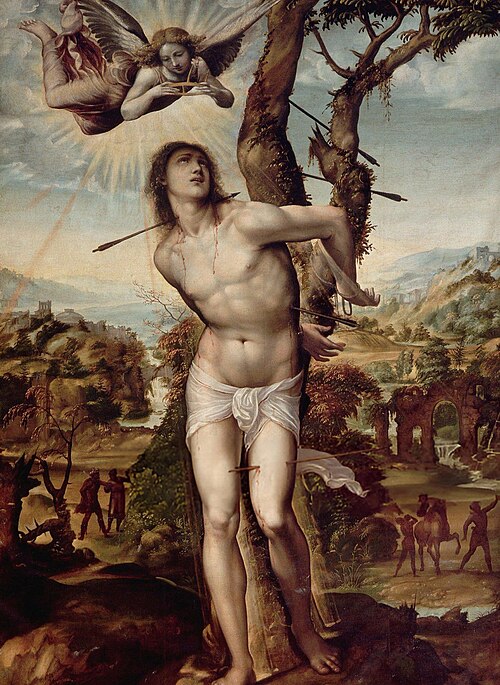
Saint Sebastian
Martyr
- Feast Day
- January 20
- Life
- d. 288
- Born
- Narbonne, Gaul (per Ambrose) or Milan
Sebastian was a Roman soldier martyred at Rome under the emperor Diocletian. The earliest reliable witness is Saint Ambrose of Milan, who in his commentary on Psalm 118 (sermon 22) names Sebastian as a Milanese who went to Rome and there suffered martyrdom for the faith during the persecution. The Depositio Martyrum of 354, the earliest Roman liturgical calendar, already lists his veneration on January 20 at the catacomb on the Appian Way that bears his name.
The Passio Sancti Sebastiani, a fifth-century narrative attributed to (but not certainly by) Ambrose, expanded these data: Sebastian became a captain of the imperial guard under Diocletian; while encouraging Christian prisoners he was denounced as a Christian himself; sentenced to be shot by archers, he survived and was nursed back to health by the widow Saint Irene; he then confronted the emperor publicly and was clubbed to death and his body cast into the Cloaca Maxima, from which Christians recovered it.
His tomb was placed in the catacomb on the Via Appia, around which the Constantinian Basilica Apostolorum, later called Saint Sebastian Outside the Walls, was built. His name is inserted in the second list of the Roman Canon (Eucharistic Prayer I).
Sebastian's veneration spread widely through Italy and Gaul, and from the seventh century especially as a protector against plague, after his intercession was credited with the lifting of an epidemic at Pavia in 680. The General Roman Calendar retains his Optional Memorial on January 20.
Sebastian represents the martyrs of the army of Diocletian and shows that fidelity to Christ could be lived out within the Roman military as well as in withdrawal from it. His name in the Roman Canon places him in the constant memory of the Eucharistic celebration. The arrows of his iconography became, in Christian tradition, the figures of the plague, and his intercession was sought as the Church faced epidemic disease through medieval and early-modern Europe.
Patronages
soldiers · athletes · archers · those suffering plague
Catholic Churches Named After Saint Sebastian
20 parishes on Catholic Church Times share Saint Sebastian's name. Find their Mass times, confession schedules, and adoration hours:
- Sankt Sebastian — Sauldorf
- St. Sebastian — Hofbieber
- Sebastianskapelle — Ellwangen (Jagst)
- St. Sebastian Church — Santa Paula, CA
- St. Sebastians-Kapelle — Garmisch-Partenkirchen
- Sankt Sebastian — Münster
- Sankt Fabian und Sebastian — Marsberg
- St. Sebastian Church — Milwaukee, WI
- Sankt Sebastianus Kapelle — Weeze
- St. Sebastian — Furth
- St. Sebastian — Oberkirch
- St. Sebastian
- Friedhofskapelle St. Sebastian — Leuchtenberg
- St. Sebastian — Michelstadt
- Sebastianskirche — Salzburg
- Friedhofskirche St. Sebastian — Schongau
- St. Sebastian — Breitengüßbach
- Katholische Kirche St. Sebastian — Brülisau
- St. Sebastian — Hünfeld
- St. Sebastian — Hallerndorf
Sources