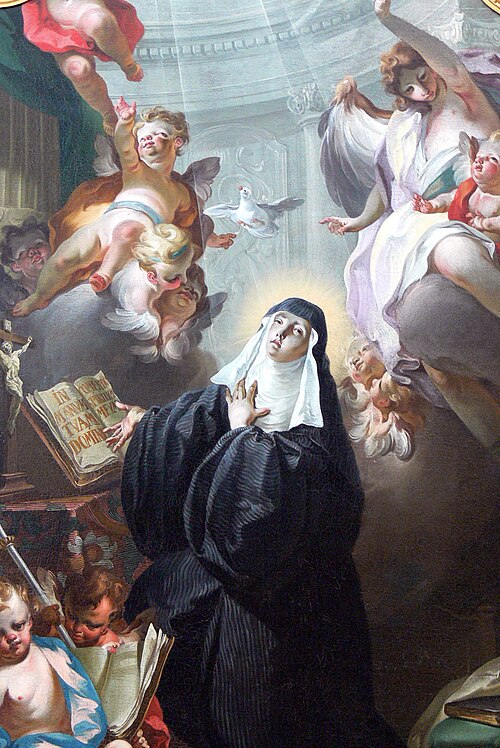
Saint Scholastica
Virgin
- Feast Day
- February 10
- Life
- 480–543
- Order
- Order of Saint Benedict (OSB)
- Born
- Nursia (Norcia), Umbria
Scholastica was the sister, by tradition the twin sister, of Saint Benedict of Nursia. The principal historical source for her life is book II of the Dialogues of Pope Saint Gregory the Great, written about 593, drawing on the witness of monks who had known Benedict.
Gregory reports (Dialogues II, 33-34) that Scholastica had consecrated her virginity to God from an early age and lived in a community of women near Monte Cassino, the abbey her brother had founded about 529. Once a year Benedict came down to meet her at a cell on his property, where they spoke of God for the day.
On their last meeting, the year of her death, Scholastica asked her brother to remain through the night, that they might continue to speak of the joys of heaven. Benedict refused, on grounds of his Rule. Scholastica laid her hands on the table in prayer, and, although the sky had been clear, a violent storm broke out so that Benedict could not leave. Reproached by him, she answered: "I asked you and you would not listen to me, so I asked my God and he listened to me." They spent the night in spiritual conversation. Three days later, from his monastery, Benedict saw her soul ascending to heaven in the form of a dove. He had her body brought to Monte Cassino and buried in the tomb he had prepared for himself.
Gregory comments: "She was able to do more, because she loved more" (plus potuit quae plus amavit). Scholastica is therefore venerated as the foundress of female Benedictine monasticism in the West, sister and counterpart of the patriarch of Western monasticism. The General Roman Calendar inscribes her memorial on February 10.
Saint Gregory's account of Scholastica is brief but doctrinally weighty. Her last meeting with Benedict, in which her prayer prevailed even against his Rule, became in the tradition a parable of charity surpassing law. Female Benedictine monasticism worldwide takes her as its founding figure. She holds, with Saint Mary Magdalene and Saint Mary, a particular place in the iconographic and liturgical tradition of the Benedictines as the companion of the patriarch.
Patronages
Benedictine nuns · education · convulsive children · against storms
Catholic Churches Named After Saint Scholastica
18 parishes on Catholic Church Times share Saint Scholastica's name. Find their Mass times, confession schedules, and adoration hours:
- St. Scholastica Catholic Church — Erie, CO
- St. Scholastica Chapel — Atchison, KS
- St. Scholastica — Heidelberg, MN
- Church of St. Scholastica — Letcher, SD
- Church of St. Scholastica — Bristol, WI
- St. Scholastica's Convent — Baguio
- St. Scholastica Parish — Detroit, MI
- Saint Scholastica Chapel — Baguio, Cordillera Administrative Region
- Benedictine Sisters of Boerne, St. Scholastica Monastery — Boerne, TX
- St. Scholastica Roman Catholic Church — Lecanto, FL
- St. Scholastica — Burr, SK
- Mount St. Scholastica Monastery — Atchison, KS
- St Scholastica's, Bennettswood — Bennettswood, VIC
- St. Scholastica — Woodridge, IL
- St. Scholastica — Aspinwall, PA
- St. Scholastica Monastery — Fort Smith, AR
- St. Scholastica Catholic Church — New Blaine, AR
- St. Mary's Monastery & St. Scholastica Priory — Petersham, MA
Sources