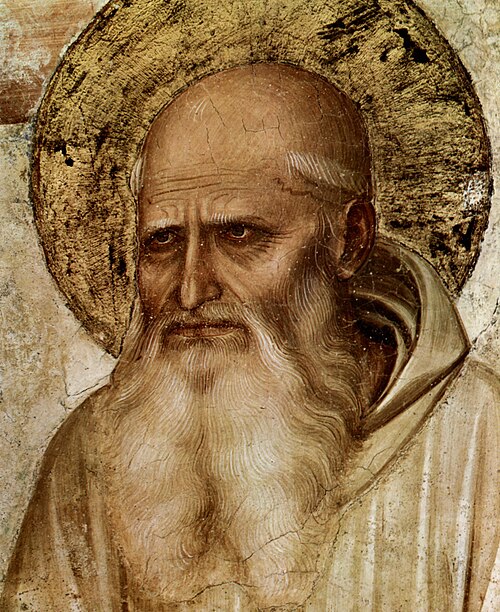
Saint Romuald
Abbot
- Feast Day
- June 19
- Life
- 951–1027
- Canonized
- 1595
- Order
- Order of Saint Benedict (Camaldolese reform, OSB Cam.)
- Born
- Ravenna, Italy
Saint Romuald was born about 951 at Ravenna of the noble Onesti family. After witnessing his father kill a kinsman in a duel, he entered the Benedictine monastery of Sant'Apollinare in Classe at Ravenna for forty days of penance, then took the habit. Seeking a more austere life, he passed under several spiritual fathers, including a Venetian hermit named Marinus and the Catalan abbot Saint Guarinus at the monastery of Cuxa in the Pyrenees.
For nearly fifty years Romuald moved through Italy, France, and Hungary, founding hermitages and reforming or founding monasteries that united Benedictine cenobitic life with the eremitical tradition of the Egyptian and Syrian Fathers. About 1023 he established the hermitage of Camaldoli in the Casentino mountains of Tuscany; the form of life he gave it, with hermits in individual cells around a common church and a small cenobium nearby, became the Camaldolese Benedictine reform.
The principal source for his life is the Vita Beati Romualdi by Saint Peter Damian, written about 1042, only fifteen years after Romuald's death. Romuald died alone in his cell at Val di Castro on June 19, 1027. Pope Clement VIII confirmed his cult and inscribed him in the Roman Martyrology in 1595, equivalent to canonization. The Camaldolese Order continues to flourish at Camaldoli and elsewhere.
Romuald's Brief Rule, preserved in a single short paragraph by Bruno of Querfurt, is a classic of Western contemplative spirituality: Sit in your cell as in paradise; cast all memory of the world behind you. Watch your thoughts as a good fisherman watches for fish. The Camaldolese tradition has remained one of the principal homes of Christian eremitical life in the Latin Church.
Patronages
the Camaldolese Order
Catholic Churches Named After Saint Romuald
14 parishes on Catholic Church Times share Saint Romuald's name. Find their Mass times, confession schedules, and adoration hours:
- La paroisse Saint-Romuald — Moffet, QC
- Ss Mary and Romuald — Yarm, ENG
- Paroisse Saint-Romuald — Farnham, QC
- Sv. Romuald i Svi Sveti — Rijeka, HR
- St. Romuald Catholic Church — Hardinsburg, KY
- Église Saint-Romuald — Lévis, QC
- Chiesa di Santa Maria Assunta e San Romualdo. — San Pietro di Feletto
- Saint-Romuald — Farnham, QC
- Paroisse Saint-Romuald de Moffet — Moffet, QC
- St. Romuald — Wakefield, RI
- Chiesa dei Santi Biagio e Romualdo — Fabriano
- Chiesa di San Romualdo Abate — Roma
- Parroquia San Romualdo — Madrid, Madrid
- Chiesa di San Romualdo (Ravenna, San Romualdo) — Ravenna
Sources