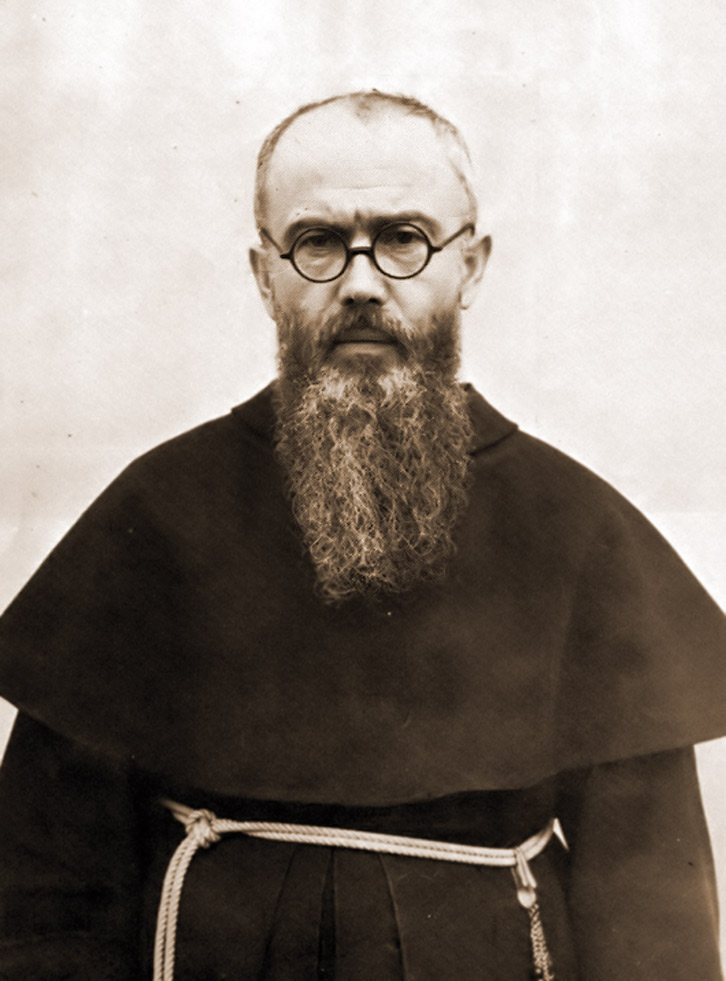
Saint Maximilian Mary Kolbe
Priest and Martyr
- Feast Day
- August 14
- Life
- 1894–1941
- Canonized
- 1982
- Order
- Order of Friars Minor Conventual (OFM Conv.)
- Born
- Zdunska Wola, Russian Partition of Poland
Saint Maximilian Kolbe was born Raymund Kolbe at Zdunska Wola in Russian-controlled Poland on January 8, 1894, the second of five sons of a poor weaver family. As a boy he received a vision in which the Blessed Virgin Mary offered him two crowns, one white for purity and one red for martyrdom; he later said he chose both. He entered the Conventual Franciscans in 1907, taking the religious name Maximilian, was sent to Rome for studies, and earned doctorates in philosophy at the Gregorian (1915) and theology at the Pontifical Theological Faculty of Saint Bonaventure (1919).
While still a student in Rome, on October 16, 1917 (during the climax of the Fatima apparitions and on the day Italian Freemasons celebrated their bicentennial in Saint Peter's Square), Kolbe and six confreres founded the Militia Immaculatae (Knights of the Immaculate), a movement of total consecration to the Immaculate Mother of God for the conversion of sinners and the spread of the Catholic faith, especially through the modern means of communication. Ordained priest in Rome on April 28, 1918, he returned to Poland in 1919.
To diffuse the message of the Immaculate, Kolbe founded a monthly review, Rycerz Niepokalanej (Knight of the Immaculate), in 1922. Its rapid growth required a printing press; for this Kolbe established in 1927 the City of the Immaculate (Niepokalanow) at Teresin near Warsaw, a Conventual Franciscan friary that became one of the largest religious houses in the world (762 friars at its peak in 1939) and the publisher of the largest-circulation Catholic monthly in interwar Europe. From 1930 to 1936 he led an analogous foundation, Mugenzai no Sono (Garden of the Immaculate), at Nagasaki in Japan, with a Japanese-language Knight of the Immaculate.
After the German invasion of Poland in 1939, Niepokalanow sheltered up to 3,000 refugees, including some 1,500 Polish Jews. Kolbe was arrested by the Gestapo on February 17, 1941, and after three months at Pawiak prison was transferred to Auschwitz on May 28, 1941, as prisoner number 16670.
At the end of July 1941, after the escape of a prisoner from his block, the SS commander selected ten men to die by starvation as a reprisal. Among them was Sergeant Franciszek Gajowniczek, who cried out, My poor wife, my poor children! Kolbe stepped forward and asked the commander to accept him in place of Gajowniczek; the request was granted. Kolbe led his nine fellow condemned in prayer and song in the starvation bunker, and after two weeks, on August 14, 1941, when only he was still alive, he was killed by an injection of carbolic acid. He was forty-seven. His body was cremated the next day, the Solemnity of the Assumption.
Pope Saint Paul VI beatified Maximilian Kolbe on October 17, 1971, as a confessor. Pope Saint John Paul II, who as a young man in occupied Poland had known of Kolbe and Niepokalanow, canonized him at Saint Peter's on October 10, 1982, declaring him in the canonization decree martyr of charity, and in his homily called him a martyr in the strict sense. Franciszek Gajowniczek, who had been miraculously spared and survived Auschwitz, was present at the canonization with his wife.
Pope Saint John Paul II's 1982 canonization established Saint Maximilian Kolbe as the great witness of voluntary substitutionary martyrdom of the twentieth century, the priest who, in the words of his canonization homily, gave the supreme proof that greater love has no man than this, that a man lay down his life for his friends (John 15:13). The Militia Immaculatae and the Niepokalanow community remain active, and August 14, the eve of the Assumption, falls within a strong Marian register, expressing Kolbe's lifelong consecration to the Immaculate.
Patronages
prisoners · drug addicts · journalists · amateur radio operators · the pro-life movement · families
Catholic Churches Named After Saint Maximilian Mary Kolbe
1 parish on Catholic Church Times share Saint Maximilian Mary Kolbe's name. Find their Mass times, confession schedules, and adoration hours:
- Saint Maximilian Mary Kolbe Parish Church — Caloocan, National Capital Region
Sources