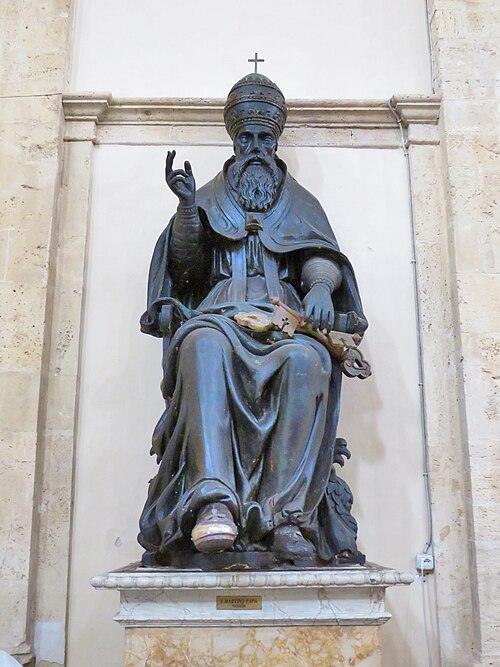
Saint Martin I
Pope and Martyr
- Feast Day
- April 13
- Life
- d. 655
- Born
- Todi, Umbria
Martin was born at Todi in Umbria of unknown date and served as papal apocrisiarius (representative) at Constantinople before his election to the See of Rome. He was consecrated bishop of Rome in July 649 without seeking the customary confirmation of the Byzantine emperor Constans II.
Within months of his election he convoked the Lateran Council of October 649, which condemned the Monothelite heresy taught with imperial support, declaring that Christ possesses two wills, divine and human, corresponding to his two natures, against the doctrine that he had only a single (divine) will. The acts of this council, framed in the presence of more than one hundred bishops, became a foundational text of orthodox Christology and were drawn upon by the Sixth Ecumenical Council (Constantinople III, 681).
Constans II, enraged by the Pope's defiance, sent the exarch Theodore Calliopas to arrest him. Martin was seized at the Lateran Basilica on June 17, 653, while suffering from gout, taken to Constantinople, tried for treason, condemned, and stripped of his episcopal dignity. After grievous mistreatment he was exiled to Cherson in the Crimea, where he died of his sufferings on September 16, 655.
He is the last Pope venerated as a martyr by the Latin Church. The Roman Martyrology assigns his memorial to April 13.
Saint Martin I is a witness to the Church's liberty before the civil power. His Lateran Council of 649 stands as one of the most important pre-Nicaean papal acts on Christology, defining the doctrine of two wills in Christ that was later confirmed by the Sixth Ecumenical Council. His martyrdom under a Christian emperor for resisting an imperially imposed heresy gave the Latin Church a foundational case of papal independence from imperial Caesaropapism.
Catholic Churches Named After Saint Martin I
2 parishes on Catholic Church Times share Saint Martin I's name. Find their Mass times, confession schedules, and adoration hours:
- St. Martin I — Chrisney, IN
- Katholisches Pfarramt Sankt Martin in Oestrich — Oestrich-Winkel
Sources