
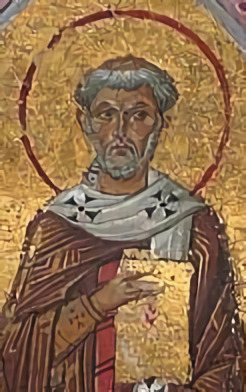
Saint Leo the Great
Pope and Doctor of the Church
- Remembered on
- November 10
- Life
- d. 461
- Doctor of the Church
- 1754
- Born
- Tuscany
About Saint Leo the Great
Leo was a native of Tuscany. In about the year 430 he became a deacon of the Church of Rome, where he came to hold an important position. In 440 Galla Placidia, who then ruled the Western Empire, sent him to Gaul to resolve a difficult situation; while he was there Pope Sixtus III died, and Leo was elected to succeed him. He was consecrated on September 29, 440, and his pontificate lasted more than twenty-one years, until his death on November 10, 461. He was buried near the tomb of Saint Peter, and his relics are preserved in the Vatican Basilica. He was the first Bishop of Rome to take the name Leo and the first Pope whose preaching to the people has come down to us.
Leo set out the faith in Jesus Christ, true God and true man, in a doctrinal letter to Flavian, Bishop of Constantinople, known as the Tome to Flavian. When it was read at the Council of Chalcedon in 451, which rejected the heresy of Eutyches, the Council Fathers acclaimed: Peter has spoken through the mouth of Leo. The Council affirmed the union of the two natures, human and divine, in the one Person of Christ, without confusion and without separation. In 452 Leo, with a Roman delegation, met Attila, chief of the Huns, at Mantua and dissuaded him from continuing his invasion of Italy. In 455 he could not prevent the Vandals of Genseric from plundering Rome, but by going out to meet the invader he prevented the city from being burned and obtained that the Basilicas of Saint Peter, Saint Paul and Saint John, where part of the population had taken refuge, were spared. Almost one hundred of his sermons and about one hundred and fifty of his letters have been preserved. Pope Benedict XIV proclaimed him a Doctor of the Church in 1754.
Why Saint Leo the Great matters
Pope Benedict XVI described Leo as both theologian and pastor, a tireless upholder of the Roman primacy who also cared for the people of Rome in a time of famine, refugees and poverty. Leo taught that the Christian liturgy is not the memory of past events but makes present invisible realities that act in the life of each believer; his firm faith in Christ, true God and true man, made him a messenger of peace, showing that in faith we learn charity.
From Saint Leo the Great
"Christian, recognize your dignity and, now that you share in God's own nature, do not return to your former base condition by sinning."
Saint lists
Catholic Parishes with Related Names
Explore 20 parishes with related names. Find their Mass times, confession schedules, and adoration hours:
- St. Leo the Great Parish - Holy Rosary — Ashley, PA
- St. Leo the Great Catholic Church — West Salem, WI
- St. Leo the Great — Amherst, NY
- St. Leo the Great — San Antonio, TX
- Church of St. Leo the Great — Bonita Springs, FL
- St. Leo the Great Catholic Church — Fairfax, VA
- St. Leo the Great Catholic Church — Cleveland, OH
- St. Leo the Great University Parish — Russellville, AR
- St Leo the Great, Altona North — Altona North, VIC
- St. Leo the Great — Tyndall, SD
- St. Leo the Great — Winston-Salem, NC
- St. Leo the Great Catholic Church — Lafayette, LA
- St. Leo the Great — Hilton, NY
- St. Leo the Great / St. Raymond — New Orleans, LA
- St. Leo The Great Catholic Church — Lancaster, PA
- Church of Saint Leo the Great — Oakland, CA
- St. Leo the Great — Leonville, LA
- St. Leo the Great Church — Waterbury, CT
- St. Leo the Great — Omaha, NE
- St. Leo the Great (Our Lady of the Eucharist Parish) — Howland, ME
Sources