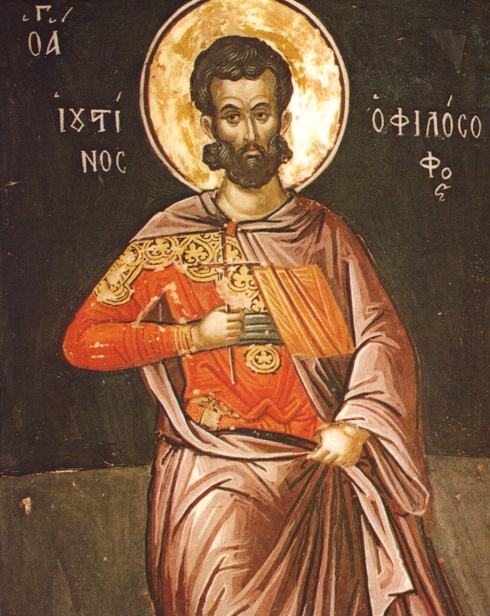
Saint Justin Martyr
Martyr
- Feast Day
- June 1
- Life
- 100–165
- Born
- Flavia Neapolis (modern Nablus), Samaria
Saint Justin was born about 100 at Flavia Neapolis (the Roman name of biblical Shechem, modern Nablus) in Samaria, of pagan Greek parents. As a young man he passed through Stoic, Aristotelian, Pythagorean, and Platonic schools in turn, dissatisfied with each. According to his own account in the Dialogue with Trypho 3-8, he encountered an old man on a beach who turned him to the Hebrew prophets and to Christ, in whom he found the true philosophy. He was baptized about 130.
Settling in Rome about 150, Justin opened a school of Christian philosophy, retaining his philosopher's cloak. His three principal works survive: the First Apology, addressed about 155 to the Emperor Antoninus Pius, defending Christians against charges of atheism and immorality and providing the earliest detailed description of the Sunday Eucharist (chapters 65-67); the Second Apology, addressed to the Roman Senate; and the Dialogue with Trypho the Jew, an extended exposition of Christ as the fulfillment of the Old Testament.
The authentic Acts of Justin and Companions, an early martyr-act of unquestioned reliability, records his trial and beheading at Rome under the prefect Junius Rusticus, about 165, in the reign of Marcus Aurelius. Six companions were martyred with him.
Justin is the first major Christian apologist and the first known philosopher to give his life for the faith. His teaching of the logoi spermatikoi, the seeds of the Word scattered among the philosophers, is foundational to Catholic theology of religions and is cited by the Second Vatican Council in Ad Gentes 11 and Lumen Gentium 16. His description of the Sunday Eucharist (First Apology 65-67) is quoted in the Catechism (CCC 1345) as the earliest witness to the structure of the Mass.
Patronages
philosophers · apologists · lecturers
Catholic Churches Named After Saint Justin Martyr
8 parishes on Catholic Church Times share Saint Justin Martyr's name. Find their Mass times, confession schedules, and adoration hours:
- St. Justin Martyr Catholic Community — Houston, TX
- St. Justin Martyr Parish, Unionville — Unionville, ON
- St. Justin Martyr — Sunset Hills, MO
- Church of St. Justin Martyr — St. Louis, MO
- St. Justin Martyr Catholic Church — Chicago, IL
- St. Justin Martyr Catholic Church — Eastlake, OH
- St. Justin Martyr Catholic Church — Key Largo, FL
- St. Justin Martyr Parish — London, ON
Sources