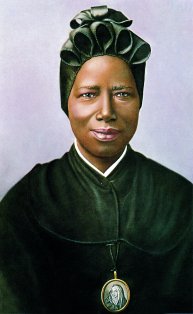
Saint Josephine Bakhita
Virgin
- Feast Day
- February 8
- Life
- 1869–1947
- Canonized
- 2000
- Order
- Canossian Daughters of Charity (Servants of Charity, FdCC)
- Born
- Olgossa, Darfur, Sudan
Bakhita was born about 1869 in the village of Olgossa in the Darfur region of Sudan. About age seven (by her own later reckoning) she was abducted by Arab slave traders, who gave her the name Bakhita, "the lucky one," because she had forgotten her birth name in the trauma. She was sold five times in the slave markets of El Obeid and Khartoum, suffering harsh treatment under several masters, including being branded with hot irons.
In 1883 she was bought by the Italian consul Callisto Legnani in Khartoum, who treated her humanely. When the Mahdist War forced Legnani to leave Sudan in 1885, he agreed to bring Bakhita with him to Italy, where she was placed in service to the family of Augusto Michieli at Mirano Veneto and entrusted with the care of their daughter Mimmina. In 1888 the Michieli family entrusted Bakhita and Mimmina to the Canossian Daughters of Charity in Venice. There Bakhita received instruction in the Catholic faith.
When the Michieli family returned to claim her, she refused, with the support of the canossians, the patriarch of Venice Cardinal Domenico Agostini, and an Italian magistrate; the court declared on November 29, 1889, that since slavery was illegal in Italy, Bakhita had been free since her arrival. On January 9, 1890, she was baptized, confirmed, and received first Communion at the hands of the future Pope Saint Pius X, then patriarch of Venice. She took the name Josephine.
She entered the Canossian novitiate in 1893 and made her religious profession on December 8, 1896. From 1902 until her death she lived at the Canossian convent in Schio in the Veneto, where she served as cook, sacristan, and portress. She wrote (or dictated) her autobiography, Storia meravigliosa, which was published in 1931. She died at Schio on February 8, 1947.
She was beatified by Pope Saint John Paul II on May 17, 1992, and canonized by him on October 1, 2000. In his canonization homily John Paul II called her "a shining advocate of genuine emancipation" whose life "inspires not passive acceptance but the firm resolve to work effectively to free girls and women from oppression and violence." Pope Benedict XVI's encyclical Spe Salvi (2007) opens its second section with an extended meditation on Bakhita's life as an icon of Christian hope.
Bakhita is the African saint of the modern Church and the patron of victims of human trafficking. The United Nations has designated February 8, her memorial, as the International Day of Prayer and Awareness against Human Trafficking, reflecting Catholic advocacy for its observance. Benedict XVI in Spe Salvi (n. 3) used her life as the principal modern illustration of the difference made by encountering Christ as the true Master.
Patronages
Sudan · victims of human trafficking · survivors of slavery
Catholic Churches Named After Saint Josephine Bakhita
10 parishes on Catholic Church Times share Saint Josephine Bakhita's name. Find their Mass times, confession schedules, and adoration hours:
- St. Josephine Bakhita — New Orleans, LA
- Church of St. Josephine Bakhita — Sioux Falls, SD
- Most Holy Trinity (St. Josephine Bakhita) — Saint Louis, MO
- Sts. Teresa and Bridget (St. Josephine Bakhita) — Saint Louis, MO
- St. Josephine Bakhita African-Caribbean Catholic Community — London, ON
- St Josephine Bakhita Centre — Westminster - African and Sudanese Catholic Community, WA
- St. Nicholas (St. Josephine Bakhita Parish) — Saint Louis, MO
- St. Josephine Bakhita — Phoenix, AZ
- St. Josephine Bakhita — Crossroads, Af
- St. Josephine Bakhita Parish, Mississauga — Mississauga, ON
Sources