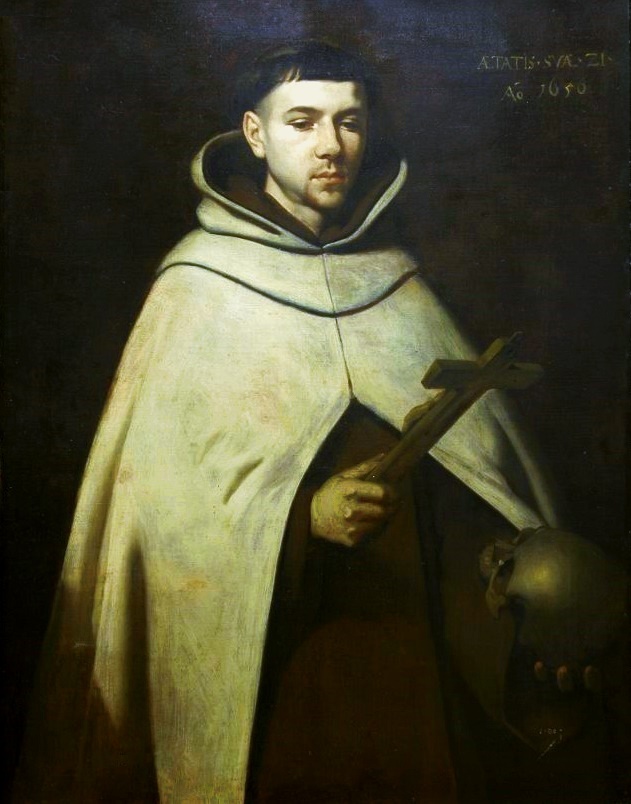
Saint John of the Cross
Priest and Doctor of the Church
- Feast Day
- December 14
- Life
- 1542–1591
- Canonized
- 1726
- Doctor of the Church
- 1926
- Order
- Order of Discalced Carmelites (co-founder of the friars)
- Born
- Fontiveros, Old Castile, Spain
Juan de Yepes Alvarez was born on June 24, 1542, at Fontiveros in Old Castile, the youngest son of a poor weaving family. After his father's early death the family moved to Medina del Campo; the young Juan worked from age fourteen at a hospital for the incurably ill while studying at the local Jesuit college. In 1563 he entered the Carmelite Order and was sent to the great University of Salamanca for theological studies, returning ordained priest in 1567. There he met Saint Teresa of Avila, twenty-seven years his senior, who was already engaged in the reform of the Carmelite nuns; she enlisted him to extend the Discalced (reformed) reform to the friars. With one companion he opened the first Discalced friary at the village of Duruelo in 1568.
The reform met fierce internal opposition from the larger body of unreformed Carmelites. In December 1577 Juan was abducted by his unreformed brethren in Avila and imprisoned for nearly nine months in a Toledo monastery cell six by ten feet, with periodic public scourgings. There, in the dark, he composed the first stanzas of the Spiritual Canticle, perhaps the greatest mystical lyric in the Spanish language. He escaped in August 1578 and returned to the work of the reform, founding houses, holding senior offices in the new province after its 1581 separation from the Calced Carmelites, and continuing to write. His four major prose works - The Ascent of Mount Carmel, The Dark Night of the Soul, The Spiritual Canticle, and The Living Flame of Love - are commentaries on his own poetry and constitute, together with the writings of Saint Teresa, the foundational corpus of Spanish mystical theology. He died at the friary of Ubeda on December 14, 1591, age forty-nine. Pope Benedict XIII canonized him in 1726, and Pope Pius XI declared him a Doctor of the Church on August 24, 1926, with the title Doctor Mysticus.
John of the Cross is the doctor of the dark night - the experience by which God purifies the soul of all that is not himself, often through the apparent absence of consolation. His teaching is uncompromising about the cost of contemplative union with God and equally uncompromising about its reality: nada, nada, nada, nada, nada, y aun en el monte nada - nothing, nothing, nothing, and on the mountain still nothing - that is, nothing but God himself.
Patronages
mystics · contemplatives · Spanish poets
From Saint John of the Cross
"In the evening of life, we shall be judged on love."
Catholic Churches Named After Saint John of the Cross
20 parishes on Catholic Church Times share Saint John of the Cross's name. Find their Mass times, confession schedules, and adoration hours:
- St. John the Evangelist — Green Bay, WI
- John Paul II Roman Catholic Center — Chicago, IL
- Basilica of St. John — Des Moines, IA
- St. John and Visitation Parish — Bronx, NY
- St. John the Baptist — Edgar, WI
- St.John Evangelist — Hilden, DELAWARE
- St. John the Evangelist — Independence, IA
- St. John the Baptist Roman Catholic Church — New Haven, CT
- St. John the Baptist — Detroit, MI
- St. John the Evangelist — Tubingen, Baden-Wurttemberg
- SS. John and Catherine — Mount Carroll, IL
- St. John Paul II — Santa Teresa, NM
- St. John the Evangelist — Gillett, WI
- St. John (deaf center chapel) — Eastpointe, MI
- St. Mary Parish (St. John XXIII Parish) — Evanston, IL
- St. John's Catholic Church — Wauneta, NE
- Sts. John and Elizabeth Catholic Church — Grayson, KY
- St. John the Baptist — New Orleans, LA
- St. John's Catholic Church — Onawa, IA
- St. John the Baptist — Bayonne, NJ
Sources