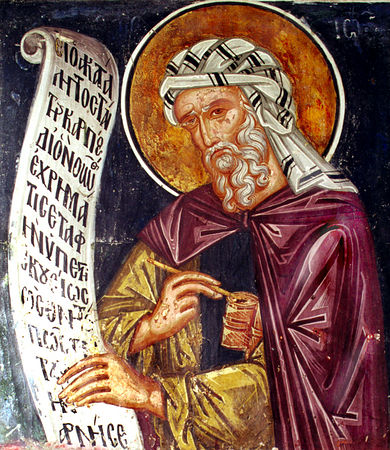
Saint John Damascene
Priest and Doctor of the Church
- Feast Day
- December 4
- Life
- 675–749
- Doctor of the Church
- 1890
- Order
- Monk of Mar Saba (Palestinian Greek monasticism)
- Born
- Damascus, Umayyad Caliphate (modern Syria)
Mansur ibn Sarjun, known to the Church as John of Damascus, was born around 675 in Damascus, capital of the new Umayyad Caliphate. His Christian Arab family held the high civil office of Mansur (treasurer) at the caliph's court, an office his grandfather had held under the Byzantines and continued to hold under Muslim rule. John succeeded to the office and served the caliph as a senior Christian official until, around the year 705, he resigned all secular employment, distributed his wealth, and entered the great Greek monastery of Mar Saba in the Judean desert south of Jerusalem, where he was eventually ordained priest by the Patriarch of Jerusalem.
His chief life-work was the synthesis of Greek patristic theology in the comprehensive Fount of Knowledge (Pege Gnoseos), whose third part, the Exact Exposition of the Orthodox Faith, became the standard manual of Greek dogmatic theology and decisively influenced Latin Scholasticism through its use by Saint Thomas Aquinas. From the relative safety of the caliphate, John mounted the most thorough Christian defense of the veneration of holy images during the Byzantine iconoclast crisis (726-787), composing three Apologetic Treatises in Defense of the Holy Images. The Council of Hieria (754), iconoclast and convened after his death, anathematized him by name; the Second Council of Nicaea (787) vindicated his teaching and the veneration of icons. He died at Mar Saba around 749. Pope Leo XIII declared him a Doctor of the Church on August 19, 1890.
John Damascene is the doctor of holy images: his argument that the veneration of icons is grounded in the Incarnation - because God has taken visible flesh, the visible can now mediate the invisible - remains the Catholic and Orthodox theology of sacred art and of liturgical materiality more broadly.
Patronages
icon-painters · pharmacists · theologians
From Saint John Damascene
"I do not worship matter, I worship the God of matter, who became matter for my sake."
Sources