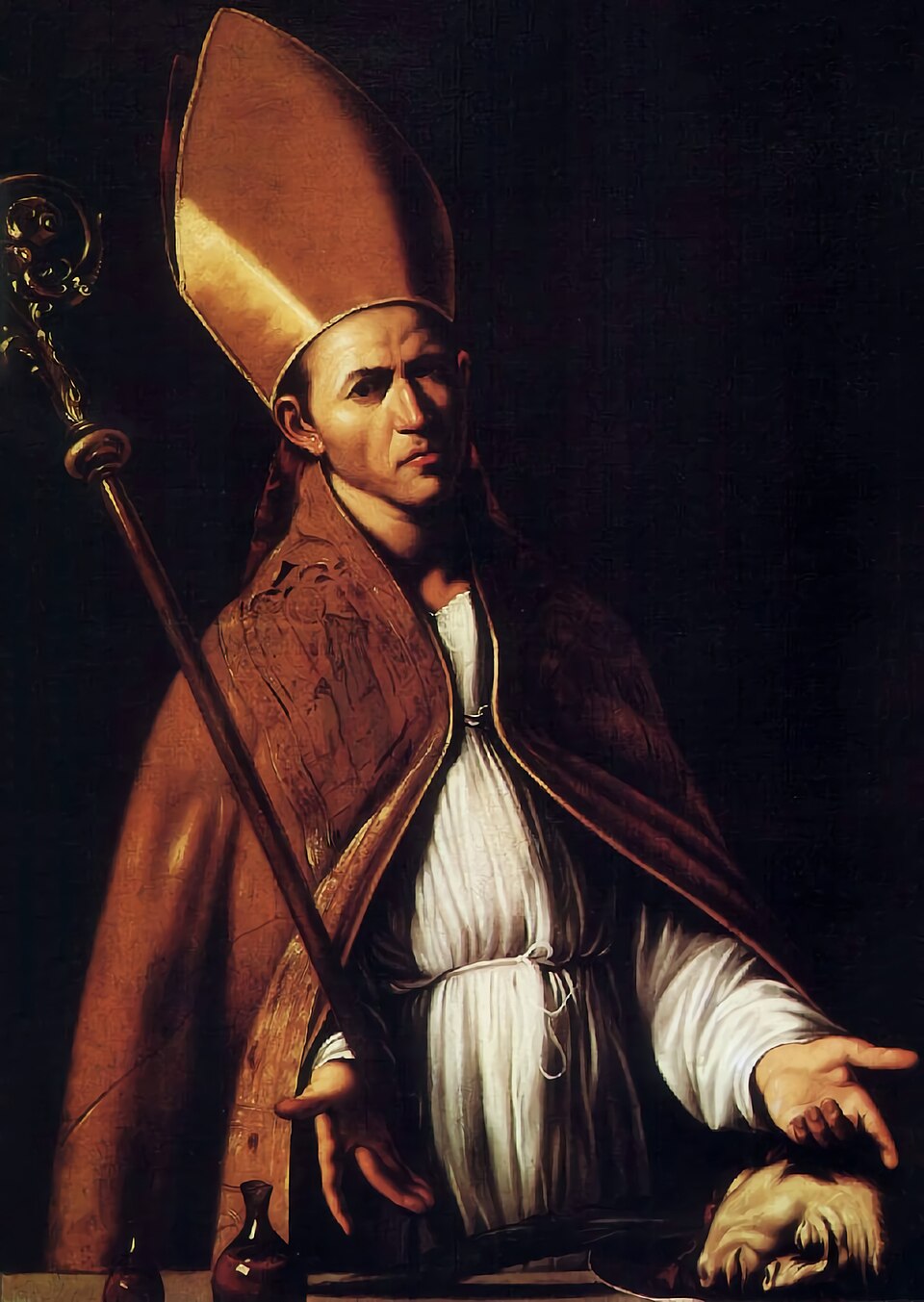
Saint Januarius
Bishop and Martyr
- Feast Day
- September 19
- Life
- d. 305
- Born
- Benevento (or Naples), Italy
Saint Januarius (Italian: San Gennaro) is honored as Bishop of Benevento and martyr under the Diocletian persecution. The earliest sources, the fifth-century Bobbio Missal and the sixth-century inscription in the Naples catacombs, attest his cultus from the early centuries. Later passiones, of varying historical reliability, recount that he was arrested while visiting imprisoned Christians at Misenum, condemned to the wild beasts at the Flavian amphitheater of Pozzuoli, and, when the beasts refused to harm him, beheaded outside the town on 19 September, traditionally in 305.
His relics were translated in the early Middle Ages, ultimately resting at the Cathedral of Naples (Duomo di San Gennaro), where they have been venerated for more than fifteen centuries. Two phials containing what tradition holds is his blood are kept in the cathedral treasury. Several times each year, on the saint's feast day, on the first Saturday of May, and on 16 December, the dried blood is publicly displayed; on most occasions over the centuries it has been observed to liquefy. The phenomenon, which Cardinal Lambertini (later Pope Benedict XIV) studied carefully, is regarded by the Church as a sign rather than a defined miracle, and no one is bound in faith to interpret it.
He is the principal patron of Naples, and his memorial on 19 September is an Optional Memorial in the General Roman Calendar.
Januarius's witness joins that of the early martyrs whose blood, in the words of Tertullian, was the seed of the Church. The piety of Naples expresses, around his feast, an unbroken communion with the persecuted Church of the first centuries.
Patronages
Naples · blood banks · volcanic eruptions
Catholic Churches Named After Saint Januarius
4 parishes on Catholic Church Times share Saint Januarius's name. Find their Mass times, confession schedules, and adoration hours:
- St. Januarius — Sprockhövel
- St. Januarius — Plum, PA
- Chapel of Januarius — Wien, Vienna
- St. Januarius Roman Catholic Church — Village of Naples, NY
Sources