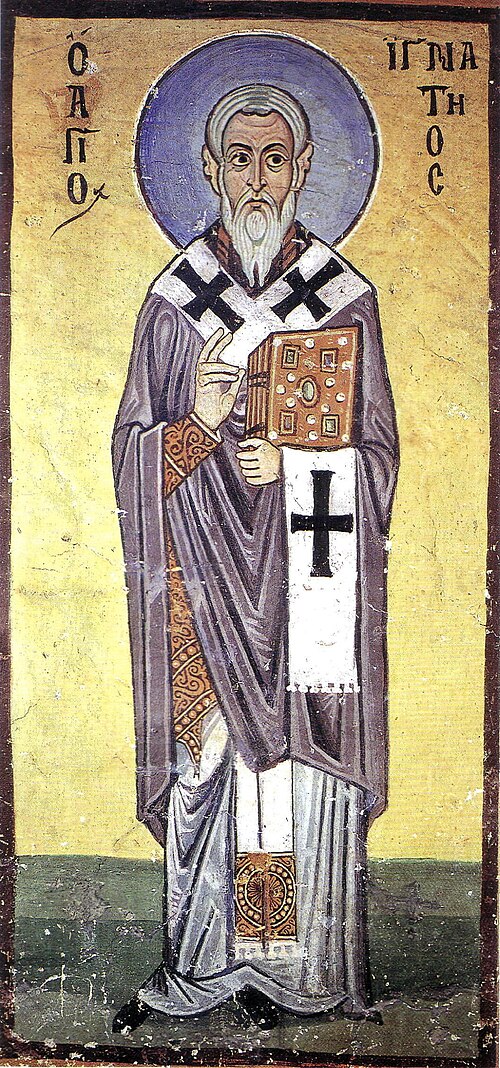
Saint Ignatius of Antioch
Bishop and Martyr
- Feast Day
- October 17
- Life
- 35–107
- Born
- Syria
Ignatius (Greek: Ignatios; Syriac: Theophorus, the God-bearer) was, according to the early second-century witness of Saint Polycarp and to Eusebius, the third Bishop of Antioch in Syria, after Saint Peter and Evodius. About the year 107, under the Emperor Trajan, he was condemned to be devoured by wild beasts at Rome and was conducted overland through Asia Minor by a guard of ten soldiers, whom he called ten leopards.
Along the route, at stations in Smyrna and Troas, he composed seven letters, six to local Christian communities (Ephesians, Magnesians, Trallians, Romans, Philadelphians, Smyrnaeans) and one to Saint Polycarp, bishop of Smyrna. These letters, the earliest substantial body of Christian literature outside the New Testament, are foundational documents of Catholic theology. They are the first to use the term Catholic Church (Smyrnaeans 8.2: Where the bishop is, there let the multitude be; just as where Jesus Christ is, there is the Catholic Church); they articulate the threefold ministry of bishop, presbyters, and deacons; they teach the real presence of Christ in the Eucharist (Smyrnaeans 7.1); and in his Letter to the Romans, Ignatius famously begs the Roman Christians not to intervene to save him: I am the wheat of God; let me be ground by the teeth of the wild beasts that I may become the pure bread of Christ.
He suffered martyrdom in the Roman amphitheater about 107. His relics were brought back to Antioch and were translated in 637 to the basilica of San Clemente in Rome. His Memorial is observed on 17 October in red.
Ignatius is the supreme apostolic Father, the bridge between the New Testament and the Church of the second century. His longing for martyrdom, expressed in language drawn from the Eucharist (Now I begin to be a disciple), gave the early Church a theology in which the Christian's whole life is a Eucharistic offering with Christ. His letters remain a primary source for the Catholic understanding of the apostolic episcopate, sacramental life, and visible unity.
Patronages
the Eastern Church · throat ailments
From Saint Ignatius of Antioch
"I am the wheat of God; let me be ground by the teeth of the wild beasts that I may become the pure bread of Christ."
Catholic Churches Named After Saint Ignatius of Antioch
20 parishes on Catholic Church Times share Saint Ignatius of Antioch's name. Find their Mass times, confession schedules, and adoration hours:
- St. Ignatius Catholic Mission — Walden, CO
- St. Ignatius of Antioch Catholic Church — Rangely, CO
- Church of St. Ignatius Martyr — City of Long Beach, NY
- Jesuitenkirche Sankt Ignatius — Landshut
- St. Ignatius — Betzdorf
- St. Ignatius Loyola Catholic Church — Cincinnati, OH
- St. Ignatius Loyola — Wanblee, SD
- St. Ignatius of Antioch — Centerville, OH
- St. Ignatius Chapel (Gonzaga University -Law School) — Spokane, WA
- St. Ignatius — Alakanuk, AK
- St. Ignatius Mission Chapel (Catholic Churches of Hancock County) — Northeast Harbor, ME
- St. Ignatius of Loyola Catholic Church — Chicago, IL
- St. Ignatius of Loyola — Los Angeles, CA
- St. Ignatius Loyola Roman Catholic Church — Hicksville, NY
- St. Ignatius — Malsch
- St. Matthias Parish-St. Ignatius of Antioch — Bobtown, PA
- St. Ignatius
- St. Ignatius Mission Parish — St. Ignatius, MT
- Chapel of St. Ignatius of Loyola — New Orleans, LA
- St. Andre Bessette Parish - St. Ignatius — Lowell, VT
Sources