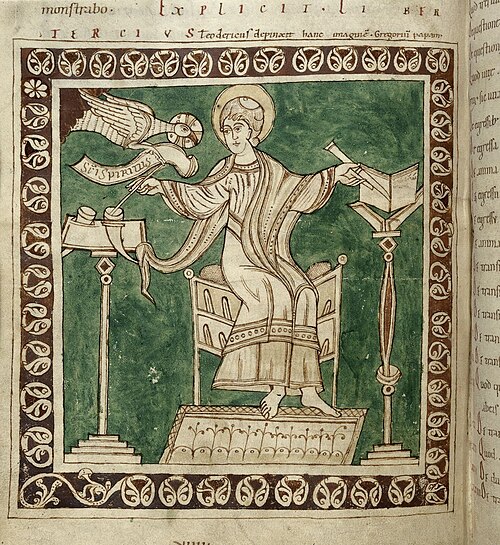
Saint Gregory the Great
Pope and Doctor of the Church
- Feast Day
- September 3
- Life
- 540–604
- Doctor of the Church
- 1295
- Order
- Benedictine
- Born
- Rome
Saint Gregory the Great was born about 540 into a wealthy Roman senatorial family. He served as prefect of Rome before withdrawing to the monastic life, converting his family palace on the Caelian Hill into a Benedictine monastery dedicated to Saint Andrew. Pope Pelagius II ordained him deacon and sent him as papal apocrisiarius (representative) to the imperial court at Constantinople, where he composed his celebrated Moralia in Job.
Elected pope in September 590 amid plague, famine and the Lombard invasions, he was consecrated reluctantly, calling himself servus servorum Dei, the servant of the servants of God, a title still used by his successors. He reorganized the Roman liturgy, encouraged what later became known as Gregorian chant, regulated the patrimony of Saint Peter to relieve the poor, and negotiated with the Lombards to spare Rome.
In 596 he sent Augustine of Canterbury with a band of monks to evangelize the Anglo-Saxons in England, a mission that bore lasting fruit. His Pastoral Rule (Regula Pastoralis) became the textbook of Christian episcopal ministry for centuries. He died on 12 March 604; his memorial was moved to 3 September, the date of his episcopal consecration. Boniface VIII declared him a Doctor of the Church in 1295, alongside Augustine, Ambrose and Jerome, the four great Latin Fathers.
Gregory's spirituality marries contemplation and action: the bishop must, he taught, ascend the mountain of prayer and descend to feed the hungry. His Dialogues popularized monastic ideals among the Christian people, and his pastoral writings continue to shape priestly formation. The phrase Christianus alter Christus, the Christian is another Christ, draws on his theology of the Mystical Body.
Patronages
musicians · singers · students · teachers
From Saint Gregory the Great
"The proof of love is in the works. Where love exists, it works great things. But when it ceases to act, it ceases to exist."
Catholic Churches Named After Saint Gregory the Great
20 parishes on Catholic Church Times share Saint Gregory the Great's name. Find their Mass times, confession schedules, and adoration hours:
- St. Gregory the Great — Milwaukee, WI
- Mary, Mother of God Parish - St. Gregory the Great — Chicago, IL
- St. Gregory the Great — San Antonio, TX
- St. Gregory the Great — Williamsville, NY
- St. Gregory the Great Catholic Church (Ordinariate) — Chestnut Hill, MA
- St. Gregory the Great — Lafayette, MN
- St. Gregory the Great — Bellerose, NY
- St. Gregory the Great Seminary — Seward, NE
- Saint Gregory the Great Parish Church — Indang, Cavite
- Saint Gregory the Great Parish Church — Laguna
- St. Gregory the Great Cathedral Parish — Legazpi City, V
- St Gregory the Great — Cheltenham, ENG
- St. Gregory the Great Catholic Church — Senatobia, MS
- St. Gregory the Great Catholic Church — Marysville, KS
- St. Gregory the Great — Enid, OK
- St. Gregory the Great Catholic Church — Houston, TX
- St Gregory the Great Catholic Church
- Saint Gregory the Great Catholic Church
- St Gregory the Great RC Church
- Saint Gregory the Great — Bogota, Bogota D.C.
Sources