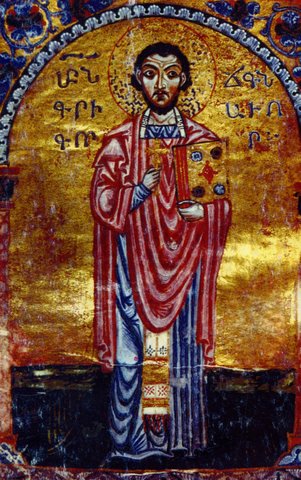
Saint Gregory of Narek
Abbot and Doctor of the Church
- Feast Day
- February 27
- Life
- 950–1003
- Doctor of the Church
- 2015
- Order
- Armenian monasticism (Narek monastery)
- Born
- Andzevatsik province, Vaspurakan, Armenia
Gregory of Narek (Grigor Narekatsi) was born about 950 in the province of Vaspurakan in the Armenian kingdom, near the southeastern shore of Lake Van. The son of Khosrov Andzevatsi, an Armenian bishop and theologian, after his mother's early death he was raised at the monastery of Narek, founded by his uncle Anania of Narek about 935.
He spent his entire adult life at Narek, where he was ordained a priest about 977, taught at the monastic school, and composed his major works. The Book of Lamentations or Book of Prayer (Matean Voghbergutyan), written in 1002, comprises ninety-five lyric poems addressed to God in the form of penitential dialogue. The work has been described as the spiritual masterpiece of Armenian literature; it has remained for a thousand years a daily companion of Armenian piety, often kept beside the bed of the sick. Gregory also wrote a commentary on the Song of Songs, an encomium on the Holy Cross, and a number of liturgical hymns (sharakans) used in the Armenian Apostolic liturgy.
He died about 1003 at Narek and was buried in the monastery church. The monastery was destroyed in the twentieth century in the wake of the Armenian Genocide of 1915 and now lies in ruins in eastern Turkey.
Gregory lived and died in communion with the Armenian Apostolic Church, which is not in full communion with the See of Rome. Pope Saint John Paul II nevertheless cited him among the Eastern Fathers in the apostolic letter Orientale Lumen (1995). On February 23, 2015, Pope Francis announced the decision to declare him a Doctor of the Universal Church, and the formal proclamation followed at the Mass for the centennial of the Armenian Genocide in Saint Peter's Basilica on April 12, 2015 (Divine Mercy Sunday). Gregory of Narek is thus to date the only Doctor of the Church who lived and died outside the Catholic communion.
Pope Francis's proclamation of Gregory of Narek as Doctor of the Church on the centenary of Metz Yeghern (the Armenian Genocide) bound the universal Church liturgically to the suffering of the Armenian people and recognized that the patrimony of the Eastern Orthodox tradition has produced figures whose witness to Christ belongs to the inheritance of the whole Church. The Book of Lamentations, with its sustained address of the human heart in penitential dialogue with God, takes its place beside the Confessions of Augustine in the Christian canon of personal prayer.
Patronages
Armenia · the Armenian people
Catholic Churches Named After Saint Gregory of Narek
20 parishes on Catholic Church Times share Saint Gregory of Narek's name. Find their Mass times, confession schedules, and adoration hours:
- St. Gregory Armenian Catholic Church — Glendale, CA
- St. Gregory Nazianzen — Los Angeles, CA
- St. Gregory the Great — Milwaukee, WI
- Mary, Mother of God Parish - St. Gregory the Great — Chicago, IL
- The Oratory of Ss. Gregory & Augustine — Richmond Heights, MO
- St. Gregory the Great — San Antonio, TX
- St. Gregory Barbarigo — Garnerville, NY
- St. Gregory — Zelienople, PA
- St. Gregory Abbey — Shawnee, OK
- St. Gregory the Great — Williamsville, NY
- St. Gregory the Great Catholic Church (Ordinariate) — Chestnut Hill, MA
- St. Gregory the Great — Lafayette, MN
- St. Gregory the Great — Bellerose, NY
- St. Gregory the Great Seminary — Seward, NE
- Church of St. Gregory — Marion, NY
- Saint Gregory the Great Parish Church — Indang, Cavite
- Saint Gregory the Great Parish Church — Laguna
- Packwood Station Community of St. Gregory the Wonderworker — Packwood, WA
- St. Gregory the Great Cathedral Parish — Legazpi City, V
- St. Gregory — Sault Ste. Marie, ON
Sources