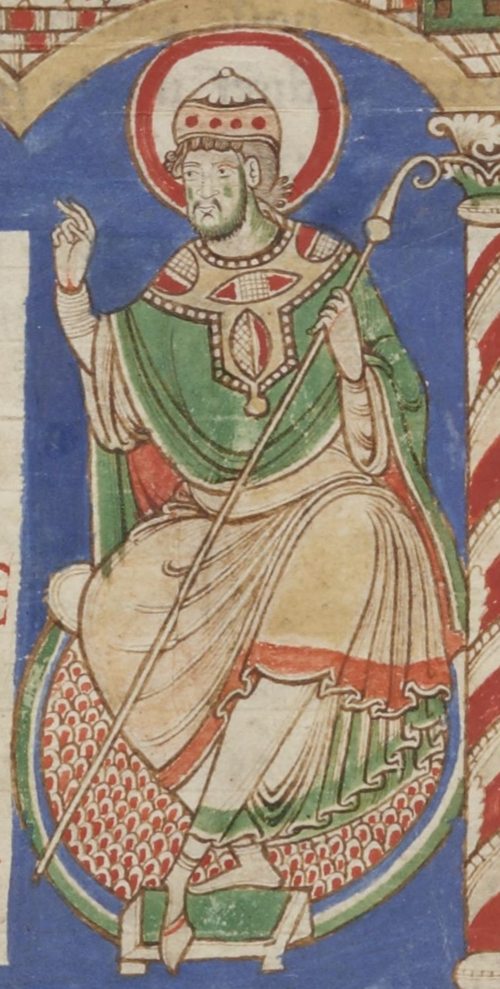
Saint Damasus I
Pope
- Feast Day
- December 11
- Life
- 305–384
- Born
- Rome (or Lusitania, debated)
Damasus was born around 305, probably in Rome to a family of Lusitanian (Iberian) origin. He served as a Roman deacon under Pope Liberius and accompanied him into exile under the Arianizing Emperor Constantius II. On Liberius's death in 366 he was elected Pope amid violent disorder; a rival faction elected Ursinus on the same day, and the schism was suppressed only after intervention by the imperial authorities. Damasus thereafter consolidated the Roman see and presided over its emergence as the unrivaled doctrinal center of Latin Christianity.
His pontificate decisively shaped the Latin Church in three ways. First, he commissioned his secretary, Saint Jerome, in 382 to revise the Old Latin Bible against the Greek and Hebrew - the project that produced the Vulgate, the Latin Bible of the Western Church for the next sixteen centuries. Second, he convened a Roman synod (probably 382) that issued the Decretum Damasi, an early authoritative statement of the canon of the Old and New Testaments and of the primacy of the Roman See as the Apostolic See of Peter. Third, he undertook a vast program of restoration and decoration of the catacombs and tombs of the Roman martyrs, composing his celebrated metrical inscriptions (the Damasine epigrams) cut in elegant capital letters by the calligrapher Furius Dionysius Filocalus and placed at the martyrs' tombs to revive their cult after the persecutions had ceased. He died in Rome on December 11, 384.
Damasus is the patron of the Catholic veneration of the Roman martyrs and of the Catholic Bible: the Vulgate of his commission was the Bible of every Latin theologian, every monastery, and every Western liturgy down to the modern era. He is also a patron of Christian archaeology - the Pontifical Commission for Sacred Archaeology bears the responsibility for the catacombs he restored.
Patronages
archaeologists
Sources