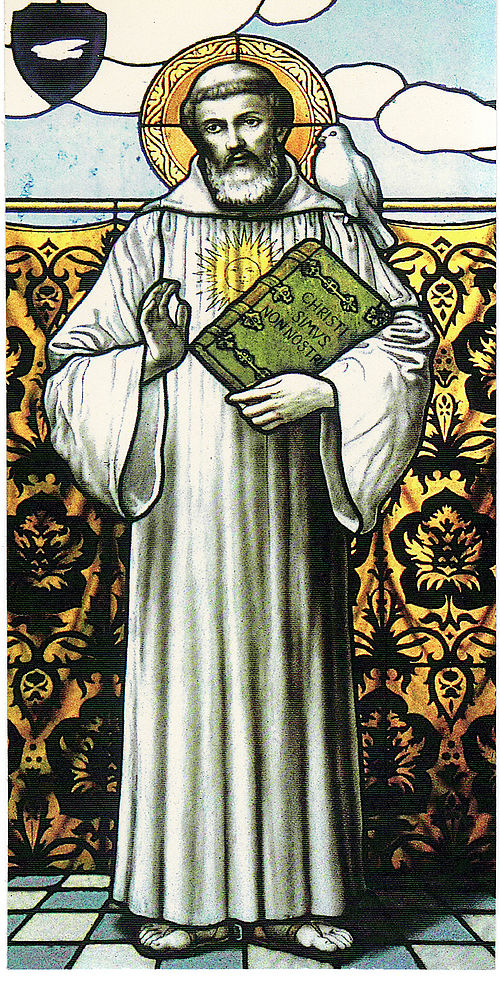
Saint Columban
Abbot
- Feast Day
- November 23
- Life
- 543–615
- Order
- Founder of the Columban monasteries (Luxeuil, Bobbio, etc.)
- Born
- Leinster, Ireland
Columban (Columbanus in Latin, distinct from Saint Columba of Iona) was born around 543 in the Irish kingdom of Leinster. He entered the monastery of Bangor in Ulster under Saint Comgall and was formed in the rigorous Irish monastic tradition. Around 590, with twelve companions, he set out as a peregrinus pro Christo (a pilgrim for the sake of Christ) to evangelize the partly Christianized but disorganized Frankish kingdoms.
In Burgundy he founded the great monastery of Luxeuil (around 590) and two daughter houses, planting Irish monastic discipline on Continental soil. His Regula monachorum and Regula coenobialis were widely adopted before being eventually displaced by the Rule of Saint Benedict; many of the proto-Benedictine houses of seventh-century Europe were Columbanian foundations. He was also the first Latin author to use the phrase totius Europae - of all Europe - in his correspondence. Forced into exile in 610 by the Frankish queen Brunhilde for rebuking the moral disorders of the court, he traveled up the Rhine to Lake Constance, where he and Saint Gall (whose foundation became the great Abbey of Sankt Gallen) preached to the still-pagan Alemanni. Columban then crossed the Alps into Lombard Italy and in 614 founded his last and most enduring monastery at Bobbio, where he died on November 23, 615. Pope Benedict XVI called him one of the Fathers of Europe.
Columban is among the patrons of Europe in fact if not in formal title: his monasteries were the seedbeds of Latin learning, agriculture, and pastoral life across post-Roman Gaul, Lombardy, and Switzerland. He is the model of the Christian missionary who is also a public conscience to political power.
Patronages
motorcyclists · Ireland's missionaries
Catholic Churches Named After Saint Columban
18 parishes on Catholic Church Times share Saint Columban's name. Find their Mass times, confession schedules, and adoration hours:
- St. Columbanus — Underwood, IA
- St. Columban Catholic Church — Garden Grove, CA
- St. Columban — Loveland, OH
- St. Columban Catholic Church — Littlefork, MN
- St. Columban — Ravensburg
- St. Columban
- Diocesan Shrine and Parish of St. Columban — Olongapo City, ZAMBALES
- St. Columbanus Parish — Elgin, ON
- Saint Columban — Olongapo City, Central Luzon
- St. Columban Catholic Church — Chillicothe, MO
- St. Columban — Cornwall, ON
- St. Columban — Los Angeles, CA
- St. Columban Catholic Church — Yelm, WA
- St. Columbanus Catholic Church — Chicago, IL
- St. Columban — Preston, MN
- St. Columbanus — Blooming Prairie, MN
- Iglesia "San Columbano" — Los Olivos
- St Columbanus — Stroud, NSW
Sources