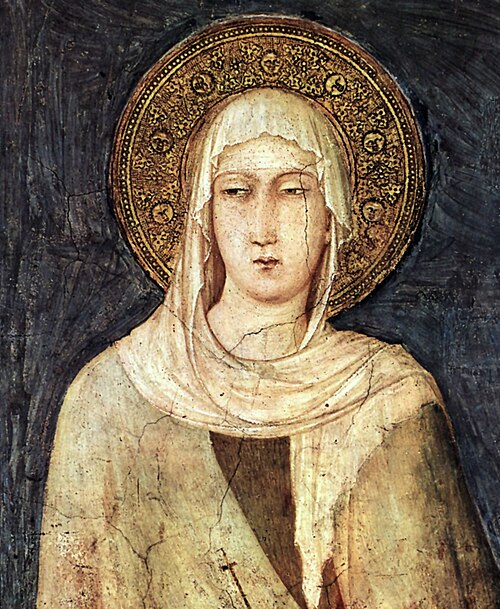
Saint Clare
Virgin
- Feast Day
- August 11
- Life
- 1194–1253
- Canonized
- 1255
- Order
- Order of Saint Clare (Poor Clares, OSC)
- Born
- Assisi, Duchy of Spoleto
Saint Clare was born Chiara Offreduccio at Assisi on July 16, 1194, daughter of the noble Favarone Offreduccio and Ortolana di Fiume. Already as a child, formed by her devout mother, she lived a life of prayer and almsgiving. As a teenager she heard the preaching of Saint Francis at the Cathedral of San Rufino in Assisi during Lent of 1212; in secret meetings she received from him direction on the religious life.
On Palm Sunday night, March 18-19, 1212, eighteen-year-old Clare fled her father's house, went to Saint Francis at the Portiuncula, exchanged her rich clothing for a coarse habit, had her hair cut as a sign of consecration, and was placed by Francis temporarily with the Benedictine nuns. After her sister Saint Agnes joined her shortly afterward, Francis settled them at the chapel of San Damiano outside the walls of Assisi (the same chapel where the crucifix had spoken to Francis at his conversion). For forty-one years, until her death in 1253, Clare lived at San Damiano as the foundress and abbess of the Order of Poor Ladies (Damianites, later Poor Clares).
The Rule she composed for her community, approved by Pope Innocent IV on her deathbed in the bull Solet annuere of August 9, 1253, was the first Rule for women religious composed by a woman, and the first to insist on the privilege of absolute poverty (privilegium paupertatis) on the Franciscan model: the community would own nothing, neither in common nor severally, but live entirely on alms. The community kept Eucharistic perpetual adoration, manual work, fasting, and silence. According to a tradition consolidated in her early biography by Tomas of Celano, when Saracen mercenaries of Frederick II besieged San Damiano in 1240, Clare carried the Blessed Sacrament in a monstrance to the convent walls and the attackers withdrew; this event has made her, on the strength of her Eucharistic vision and intercession, in a more recent association by Pope Pius XII (1958), the patron saint of television.
Clare was the first woman to be canonized formally in person rather than by general acclamation, by Pope Alexander IV at Anagni on August 15, 1255, only two years after her death on August 11, 1253. The Memorial in the General Roman Calendar is observed on August 11. Her body, with that of Saint Francis, was discovered in 1850 in the crypt of the Basilica of Santa Chiara at Assisi where it remains.
Saint Clare is the foundress of female Franciscan religious life and one of the most influential figures of medieval women's spirituality. Pope Benedict XVI, in his General Audience of September 15, 2010, praised her as a model of contemplative life lived radically in poverty, of friendship with Saint Francis, and of authentic feminine genius in the Church. The Poor Clares, with their cloistered, contemplative, perpetual-adoration life, remain one of the most extensive contemplative orders of women in the Catholic Church.
Patronages
the Order of Poor Ladies (Poor Clares) · television · embroiderers · eye disease · needleworkers · Santa Clara, California
Catholic Churches Named After Saint Clare
20 parishes on Catholic Church Times share Saint Clare's name. Find their Mass times, confession schedules, and adoration hours:
- St. Clare of Assisi — Bronx, NY
- St. Clare of Assisi Parish-St. Colette — Rolling Meadows, IL
- St. Clare — O'Fallon, IL
- St. Clare Catholic Church — Berea, KY
- St. Clare — Braintree, MA
- Poor Clares of Perpetual Adoration — Canton, OH
- St. Clare Chapel — Cincinnati, OH
- St. Clare — Clifton, NJ
- Claremont Colleges, McAllister Center Catholic Community — Claremont, CA
- St. Clare of Assisi Catholic Church — Saint Clair, PA
- St. Clare of Assisi Catholic Church — Ellisville, MO
- St. Anthony Mary Claret — San Antonio, TX
- St. Clare of Montefalco Chapel (St. Rita of Cascia Parish) — Chicago, IL
- St. Clare — Scranton, PA
- St. Clare — Albany, NY
- Church of St. Anthony Claret — Lakewood, NJ
- Mission of St. Clare — Cooper, TX
- Church of St. Clare — Florence, NJ
- Church of St. Clare — Loveladies, NJ
- St. Clare of Assisi — Clairton, PA
Sources