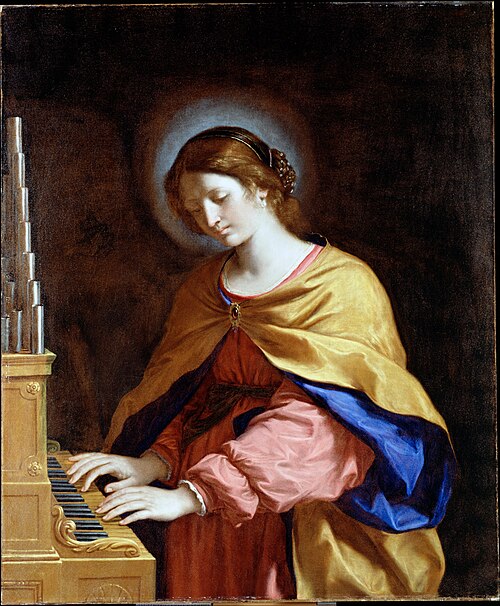
Saint Cecilia
Virgin and Martyr
- Feast Day
- November 22
- Life
- d. 230
- Born
- Rome
Cecilia is one of the most venerated of the early Roman martyrs, named in the Roman Canon (Eucharistic Prayer I) of the Mass alongside Agatha, Lucy, Agnes, Anastasia, and Perpetua and Felicity. The historical kernel is firmly established by archaeology and early Roman tradition: she was a Roman martyr buried in the Catacomb of Saint Callixtus, and a basilica was already standing on the site of her family home in the Trastevere district by the early fifth century, when Pope Symmachus held a Roman synod there in 499.
Her legendary Acts, composed in the late fifth or early sixth century, recount that she was a young Christian noblewoman of Rome who had vowed virginity to Christ and was given in marriage to a pagan named Valerian. On their wedding night she persuaded him to respect her vow and to seek baptism; he was converted along with his brother Tiburtius, and all three were eventually martyred under a persecution placed by the Acts in the reign of Marcus Aurelius (more probably under Severus Alexander, c. 230). According to the Acts she was struck three times on the neck and lingered three days before dying, and during the wedding feast she sang in her heart to God alone - the verse from which her patronage of music ultimately derives. In 1599 her tomb was opened in the basilica of Santa Cecilia in Trastevere; her body was reportedly found incorrupt, in a posture immortalized by Stefano Maderno's marble effigy that lies before the high altar to this day.
Cecilia's patronage of sacred music dates from the late Middle Ages, springing from the line in her Acts that she sang to God in her heart on her wedding day. She is the patron of every choir, schola, and parish musician who serves the liturgy.
Patronages
musicians · Church music · singers · organ-builders · poets
Catholic Churches Named After Saint Cecilia
20 parishes on Catholic Church Times share Saint Cecilia's name. Find their Mass times, confession schedules, and adoration hours:
- St. Cecilia-St. Frances Cabrini Catholic Church — East Barre, VT
- St. Cecilia — Ashland, MA
- St. Cecilia Catholic Church — Wisconsin Dells, WI
- St. Cecilia — Bainbridge Island, WA
- St. Cecilia's — Adams, NY
- St. Cecilia — Kearny, NJ
- St. Cecilia - St. Padre Pio Parish — Oakfield, NY
- St. Cecilia's Church — Saint Paul, MN
- St. Cecilia — Nashwauk, MN
- St. Cecilia — Saint Louis, MO
- St. Cecilia — San Antonio, TX
- St. Cecilia — Grindstone, PA
- SS. Philomena and Cecilia Catholic Church — Brookville, IN
- St. Cecilia — Warrensburg, NY
- St. Kateri Parish. St. Cecilia — Rochester, NY
- St. Cecilia Church — Houston, TX
- St. Cecilia Catholic Church — Jal, NM
- St. Cecilia — Jal, NM
- St. Cecilia Catholic Church — Columbus, OH
- St. Cecilia — Sanborn, IA
Sources