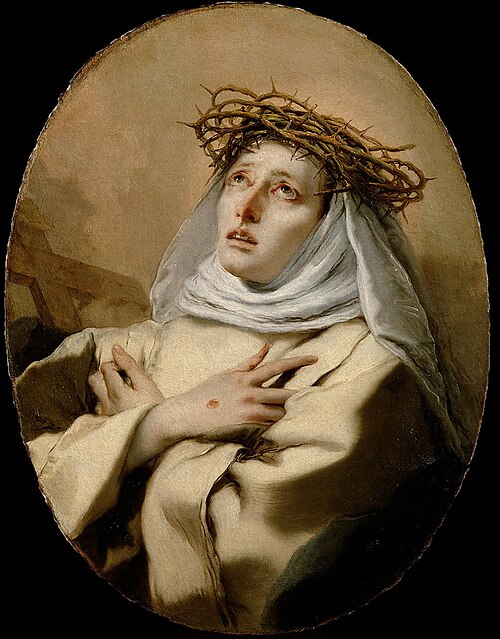
Saint Catherine of Siena
Virgin and Doctor of the Church
- Feast Day
- April 29
- Life
- 1347–1380
- Canonized
- 1461
- Doctor of the Church
- 1970
- Order
- Dominican Third Order (Mantellate)
- Born
- Siena, Republic of Siena
Caterina di Iacopo di Benincasa was born on March 25, 1347, in Siena, the twenty-third of twenty-five children of Iacopo Benincasa, a wool dyer, and Lapa Piagenti. From the age of seven, after a vision of Christ, she dedicated her virginity to him, and at sixteen she was admitted to the Mantellate, the third order of women associated with the Dominican friars of Siena.
For three years she lived in seclusion in her family's house, dedicated to prayer and severe penance. Drawn out into public life around 1370, she gathered a circle of disciples called the famiglia and undertook works of charity for the sick and poor of Siena, particularly during the plague of 1374. Her dictated letters (some 382 are preserved) treat spiritual direction, ecclesiastical reform, and political affairs and were addressed to popes, princes, and ordinary people.
Her most famous public action was her insistence that Pope Gregory XI return to Rome from Avignon. She traveled to Avignon in 1376 and her appeals contributed to Gregory's return to Rome in January 1377, ending the seventy-year Avignon papacy. During the subsequent Western Schism, she defended the legitimacy of Pope Urban VI.
Her principal written work, the Dialogue, was dictated in Siena in 1377-1378 and presents the soul's conversation with God the Father on truth, the Mystical Body, divine providence, and obedience. She received the stigmata at Pisa in 1375, visible only to herself in life.
She died at Rome on April 29, 1380, at age thirty-three. Pope Pius II canonized her on June 29, 1461. Pope Saint Paul VI declared her a Doctor of the Universal Church on October 4, 1970, the second woman so honored. Pope Saint John Paul II proclaimed her co-patroness of Europe on October 1, 1999.
Saint Catherine of Siena is one of the four women Doctors of the Church and a co-patroness of Europe. Pope Saint Paul VI's declaration Mirabilis in Ecclesia Deus (1970) identified her teaching, particularly in the Dialogue, as a privileged witness to the love of Christ Crucified and the truth of the Church. Her insistence that the Pope return from Avignon to Rome made her a model of lay engagement with the reform of the Church, while her mystical writings place her among the principal figures of Christian contemplative tradition.
Patronages
Italy · Europe · nurses · those who fight against fire
Catholic Churches Named After Saint Catherine of Siena
20 parishes on Catholic Church Times share Saint Catherine of Siena's name. Find their Mass times, confession schedules, and adoration hours:
- St.Catherine — Lenterode , Thuringen
- St. Catherine of Alexandria — Temecula, CA
- St. Catherine Catholic Church — Cathlamet, WA
- SS. John and Catherine — Mount Carroll, IL
- St. Catherine's Roman Catholic Church — Village of Port Dickinson, NY
- St. Catherine Of Siena — Ripon, WI
- St. Catherine of Alexandria Catholic Church — Milwaukee, WI
- St. Catherine Catholic Church — Milwaukee, WI
- St. Catherine of Siena Catholic Church — Trumbull, CT
- St. Catherine of Alexandria — Oconomowoc, WI
- St. Catherine of Sienna Roman Catholic Church — Franklin Square, NY
- St. Catherine of Siena — Vallejo, CA
- St. Catherine of Siena — Norwood, MA
- St. Catherine of Siena — Bolivar, MO
- St. Catherine of Siena — Springfield, MA
- St. Catherine of Siena — Addison, NY
- St. Catherine of Siena — Mendon, NY
- St. Catherine of Siena (Parish of Saint Michael the Archangel) — Clayton, NJ
- Sts. Louis & Zelie Martin Parish - St. Catherine of Genoa — Somerville, MA
- Sts.Ulric and Catherine — Landsberg, Bavaria
Sources
- https://www.vatican.va/content/paul-vi/la/apost_letters/documents/hf_p-vi_apl_19701004_mirabilis-in-ecclesia-deus.html
- https://www.vatican.va/content/john-paul-ii/en/apost_letters/1999/documents/hf_jp-ii_apl_01101999_co-patronesses-europe.html
- https://www.vatican.va/content/benedict-xvi/en/audiences/2010/documents/hf_ben-xvi_aud_20101124.html
- https://www.usccb.org/resources/2026cal.pdf