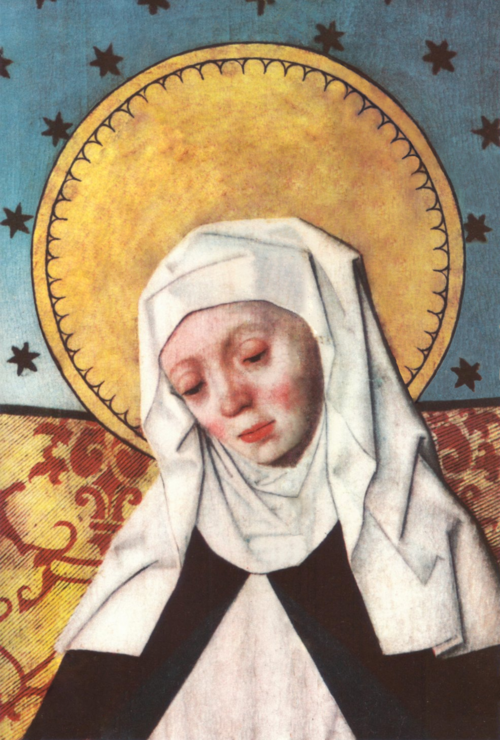
Saint Bridget of Sweden
Religious
- Feast Day
- July 23
- Life
- 1303–1373
- Canonized
- 1391
- Order
- Order of the Most Holy Saviour (Bridgettines, OSsS)
- Born
- Finsta, Uppland, Kingdom of Sweden
Saint Bridget (Birgitta) of Sweden was born in 1303 at Finsta in Uppland, Sweden, of a noble family related to the royal house. Married at thirteen to Ulf Gudmarsson, a Swedish lawman, she bore him eight children, including Saint Catherine of Sweden. She became a lady-in-waiting to Queen Blanche of Namur at the court of King Magnus IV. After a pilgrimage to Santiago de Compostela in 1341 and the death of her husband in 1344, she withdrew to a life of prayer and penance at the Cistercian monastery of Alvastra.
From childhood Bridget had received visions and supernatural locutions, which from 1344 she dictated to her confessors in Old Swedish; they were translated into Latin and collected as the Revelationes coelestes (Heavenly Revelations) in eight books, an enormous corpus of mystical theology, prophecy, and ecclesiastical exhortation. Her revelations urged the popes to return from Avignon to Rome and the Church to reform; she addressed letters in this sense to Popes Clement VI, Innocent VI, Urban V, and Gregory XI.
About 1346 she received the inspiration to found a new religious order, the Order of the Most Holy Saviour (the Bridgettines), with double monasteries of nuns and brothers under a common abbess. The Rule was approved in modified form by Pope Urban V in 1370. The mother house at Vadstena, Sweden, opened after her death and remained a major center of European spirituality until the Reformation; Vadstena Abbey is still a Bridgettine pilgrimage site today.
In 1349 Bridget moved to Rome, where for the last twenty-four years of her life she lived austerely on the Piazza Farnese, ministered to the poor, undertook pilgrimages to Assisi, Naples, Bari, and the Holy Land (1372-1373), and continued her revelations. She died in Rome on July 23, 1373; her relics were translated to Vadstena. Pope Boniface IX canonized her on October 7, 1391.
Pope Saint John Paul II proclaimed Bridget Co-Patroness of Europe, together with Saint Catherine of Siena and Saint Teresa Benedicta of the Cross (Edith Stein), in the Apostolic Letter Spes aedificandi of October 1, 1999.
Saint John Paul II's 1999 Apostolic Letter declares Bridget a witness to the unity of Christian Europe, mystic, mother of a religious family, and tireless reformer. Her revelations, especially on the Passion of Christ and the sufferings of the Mother of God, profoundly shaped late medieval devotion (the seven Crucifixion wounds and the Stations of the Cross owe much to her visions). Her popular Fifteen Prayers on the Passion of Christ, while never authenticated as her own composition, are among the most widely recited Catholic prayers.
Patronages
Europe (co-patroness) · Sweden · widows · the Bridgettine Order
Catholic Churches Named After Saint Bridget of Sweden
20 parishes on Catholic Church Times share Saint Bridget of Sweden's name. Find their Mass times, confession schedules, and adoration hours:
- St. Bridget Roman Catholic Church — Philadelphia, PA
- St. Bridget — Framingham, MA
- St. Bridget University Parish — Glassboro, NJ
- St. Bridget Parish — Pleasant Hill, MO
- St. Bridget of Sweden — Lindstrom, MN
- St. Bridget Catholic Church — Simpson, MN
- St. Bridget Roman Catholic Church — Loves Park, IL
- Church of St. Bridget of Minneapolis — Minneapolis, MN
- Mission of St. Bridget — Roanoke, WV
- St. Bridget — Trout River, NY
- St. Bridget Church, 28 Church St — West Rutland, VT
- St. Bridget Church — West Rutland, VT
- St. Bridget's Church (Blessed Trinity Parish) — Summerville, NB
- Saint Bridget's Church, Eaglesham — GLASGOW, SCT
- Sacred Heart (Bridgeton) — Glasgow, SCT
- St. Bridget Parish — Stanleyville, ON
- St. Bridget's Church (St. John Paul II Parish) — Gagetown, NB
- St. Bridget — Omaha, NE
- Saint Bridget — Geldrop, North Brabant
- St. Bridget's of the Falls Roman Catholic Church — Skaneateles Falls, NY
Sources