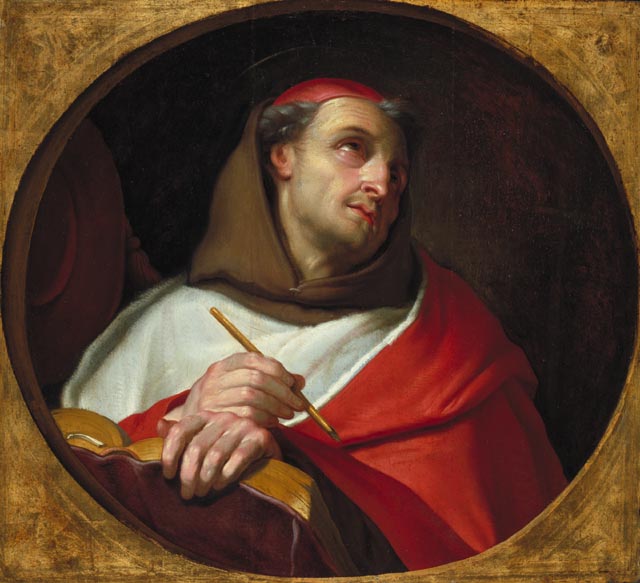
Saint Bonaventure
Bishop and Doctor of the Church
- Feast Day
- July 15
- Life
- 1217–1274
- Canonized
- 1482
- Doctor of the Church
- 1588
- Order
- Order of Friars Minor (OFM)
- Born
- Bagnoregio, Papal States
Saint Bonaventure was born Giovanni di Fidanza at Bagnoregio in central Italy about 1217. According to a tradition he himself records, his mother promised him to Saint Francis of Assisi after the saint's prayers obtained his cure from a childhood illness; the name Bonaventure (good fortune), it is said, was Francis's exclamation on seeing the recovered child. He entered the Order of Friars Minor about 1243 while a student at the University of Paris, where he was the disciple of the Franciscan master Alexander of Hales.
He received the doctorate at Paris in 1257, on the same day as Saint Thomas Aquinas, after both had been blocked from the chair of theology by secular masters opposed to the mendicants. In the same year, at age forty, he was elected Minister General of the Friars Minor, an office he held for seventeen years (1257-1274). At a moment when the order was divided between Spirituals and Conventuals, he produced the second redaction of the official biography of Saint Francis (the Legenda Maior, 1263), promulgated by the General Chapter of Pisa as the only authorized life and ordered all earlier biographies destroyed; this lost the Church the Three Companions and other early sources but preserved the unity of the order. He is honored as the second founder of the Franciscan Order.
His theological writings include the Commentary on the Sentences of Peter Lombard, the Breviloquium (a complete summary of theology), the Itinerarium Mentis in Deum (Journey of the Mind into God, 1259), composed at La Verna on the spot of Saint Francis's stigmata, and the Collationes in Hexaemeron (1273, his last unfinished course of lectures). He is the principal exponent of the Franciscan school of medieval theology, focused on the primacy of love, the centrality of Christ, the exemplarist metaphysics drawn from Saint Augustine, and the affective ascent of the soul through creation to its Creator.
Pope Gregory X created him Cardinal Bishop of Albano on May 28, 1273. As papal envoy he prepared the Second Council of Lyon, which opened May 7, 1274, and at which the schismatic Greek Church was briefly reconciled with Rome through the work of Bonaventure and the Greek delegation. He died at Lyon during the Council on July 15, 1274, and was buried in the Franciscan church there. Pope Sixtus IV (a Franciscan) canonized him on April 14, 1482; Pope Sixtus V declared him Doctor of the Church on March 14, 1588, with the title Doctor Seraphicus, the Seraphic Doctor.
Pope Benedict XVI, in three General Audiences (March 3, 10, and 17, 2010), offered an extended exposition of Bonaventure's theology, calling him the master of the contemplative spirit which orders all knowledge to the love of God. Bonaventure's Itinerarium remains the classic Franciscan handbook of mystical theology, its seven stages tracing the soul's ascent from the vestiges of God in creation, through the image of God in the soul, to ecstatic union in Christ Crucified.
Patronages
the Order of Friars Minor · Bagnoregio · workers · bowel disorders
Catholic Churches Named After Saint Bonaventure
20 parishes on Catholic Church Times share Saint Bonaventure's name. Find their Mass times, confession schedules, and adoration hours:
- St. Bonaventure University — St. Bonaventure, NY
- St. Bonaventure — San Antonio, TX
- St. Bonaventure - EM Catholic — Allegany, NY
- St. Bonaventure Catholic Church — Avondale, LA
- St. Bonaventure — Columbus, NE
- Church of St. Bonaventure — St. Elmo, IL
- Church of St. Bonaventure — Lavallette, NJ
- St. Bonaventure - St. Benedict the Moor — Jamaica, NY
- St. Bonaventure Catholic Church — Tracadie Cross, PE
- St. Bonaventure Parish — Sorsogon, SORSOGON
- St. Bonaventure Parish — Lapinig, NORTHERN SAMAR
- St. Bonaventure — Davie, FL
- St. Bonaventure Oratory — Chicago, IL
- St. Bonaventure — Killarney, ON
- Lord of Araro and Saint Bonaventure — Araro, MICH
- Saint Bonaventure — Santa Ana Maya, MICH
- Saint Bonaventure — Tezoyuca, MEX
- St. Bonaventure Mission — Cochiti Pueblo, NM
- St. Bonaventure — McIntosh, SD
- Saint Bonaventure — NARBONNE, 11
Sources
- https://www.vatican.va/content/benedict-xvi/en/audiences/2010/documents/hf_ben-xvi_aud_20100303.html
- https://www.vatican.va/content/benedict-xvi/en/audiences/2010/documents/hf_ben-xvi_aud_20100310.html
- https://www.vatican.va/content/benedict-xvi/en/audiences/2010/documents/hf_ben-xvi_aud_20100317.html