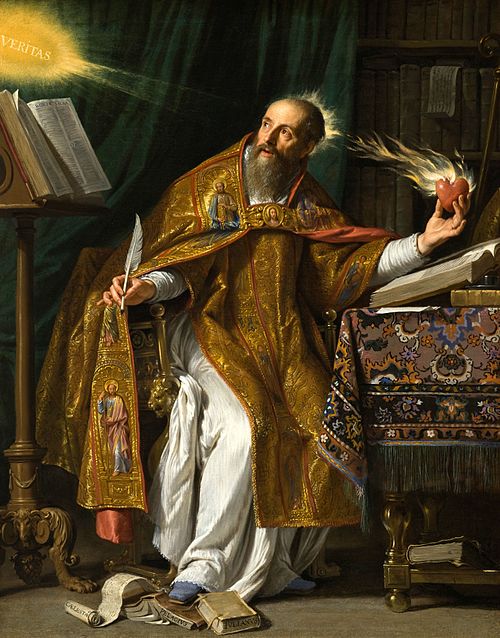
Saint Augustine
Bishop and Doctor of the Church
- Feast Day
- August 28
- Life
- 354–430
- Doctor of the Church
- 1298
- Order
- Order of Saint Augustine (OSA, by Rule)
- Born
- Thagaste, Roman North Africa (modern Souk Ahras, Algeria)
Saint Augustine was born at Thagaste in Roman Numidia on November 13, 354, son of the pagan Patricius and the Christian Saint Monica. His father provided for the education of his brilliant elder son at Madaura and Carthage in classical Latin literature and rhetoric, looking to a career in the imperial service. From age seventeen Augustine lived with a concubine at Carthage, by whom he had a son, Adeodatus (born 372). Drawn first by Cicero's Hortensius (no longer extant) to philosophy, he abandoned the catechetical Christianity of his mother for nine years of Manichaeism (a Persian dualist religion). After teaching rhetoric at Carthage and Rome, he was appointed in 384 imperial professor of rhetoric at Milan.
At Milan, the encounter with Saint Ambrose's preaching of the Catholic faith, with his mother's renewed prayers, the reading of Neoplatonist philosophy (which freed him from the materialism of Manichee dualism), and finally, in the celebrated garden of the Confessions (Book VIII, August 386), the providential opening of Saint Paul's Letter to the Romans (13:13-14) at the words Tolle, lege (take up and read), brought him to conversion. Saint Ambrose baptized him at the Easter Vigil of 387, with Adeodatus and his friend Alypius.
Returning to North Africa in 388, he founded a small monastic community at his family estate at Thagaste, where he lived with friends in study, prayer, and the practice of the Rule he was to commit to writing. On a visit to Hippo Regius in 391 he was acclaimed by the people, popularly seized, and ordained priest by Bishop Valerius. In 395 Valerius made him coadjutor bishop, and Augustine succeeded as Bishop of Hippo on Valerius's death in 396. He governed the see of Hippo for thirty-four years, until his death in 430, while preaching, teaching catechumens, presiding at the African councils, and writing the immense corpus that constitutes the foundation of Latin Catholic theology.
His principal works include the Confessions (397-401, the great spiritual autobiography); the De Doctrina Christiana (On Christian Doctrine, 396-426); the De Trinitate (On the Trinity, 399-419); the De Civitate Dei (City of God, 413-426, after the sack of Rome by the Goths in 410); the Retractations (his late catalogue of his own works); and his polemical works against the Manichees, the Donatists, and the Pelagians (Pelagius and Julian of Eclanum) on grace, free will, predestination, original sin, and Baptism. Some 350 sermons, around 270 letters, and the Enarrationes in Psalmos survive.
The Vandals under King Genseric crossed from Spain to Africa in 429 and laid siege to Hippo. Augustine, in his last weeks, had the seven penitential Psalms posted on the walls of his cell. He died on August 28, 430, in the third month of the siege, aged seventy-six. The Vandals destroyed Hippo and its diocese; Augustine's body was eventually translated by his disciples first to Sardinia, then in 723 by King Liutprand of the Lombards to Pavia, where his relics rest in the church of San Pietro in Ciel d'Oro under the great Arca di Sant'Agostino. Pope Boniface VIII formally listed him among the Doctors of the Church in 1298, with Saints Ambrose, Jerome, and Gregory the Great as the four great Latin Doctors.
Augustine is, with Saint Thomas Aquinas, the most influential theologian of the Latin Church and one of the most influential thinkers of Western civilization. His doctrine of original sin and grace shapes the Catholic dogmatic tradition definitively at the Council of Carthage (418), the Council of Orange (529), the Council of Trent (1547), and the Catechism of the Catholic Church. Pope Benedict XVI, in five successive General Audiences (January 9, 16, 30, February 20, 27, 2008), expounded the saint's life and teaching, calling him a unique master of the Christian intellectual life.
Patronages
theologians · printers · brewers · the Augustinian Order · the Diocese of Bridgeport
Catholic Churches Named After Saint Augustine
20 parishes on Catholic Church Times share Saint Augustine's name. Find their Mass times, confession schedules, and adoration hours:
- St. Augustine Church — Pleasanton, CA
- Our Lady of Good Counsel Parish-St. Theresa, St. Augustine — Methuen, MA
- St. Augustine Catholic Church — Augusta, KY
- St. Augustine Priory Catholic Church — Oxnard, CA
- St. Augustine Roman Catholic Church — Cleveland, OH
- St. Augustine — Halbur, IA
- St. Augustine's Catholic Church — Oak Harbor, WA
- St. Augustine Parish -Shrine of St. Kateri Tekakwitha — Isleta Pueblo, NM
- St. Augustine — Germantown, OH
- St. Augustine Church — South San Francisco, CA
- St. Augustine Catholic Church — San Diego, CA
- St. Augustine Parish — Waynesville, OH
- St. Augustine Oratory — South Saint Paul, MN
- St. Augustine and UM Campus Ministry — Coral Gables, FL
- St. Augustine Church — Signal Mountain, TN
- The Oratory of Ss. Gregory & Augustine — Richmond Heights, MO
- St. Augustine Catholic Church — Cohasset, MN
- St. Augustine Catholic Church — South Saint Paul, MN
- St. Augustine Catholic Church — Reed, KY
- St. Augustine Catholic Church — Union City, NJ
Sources