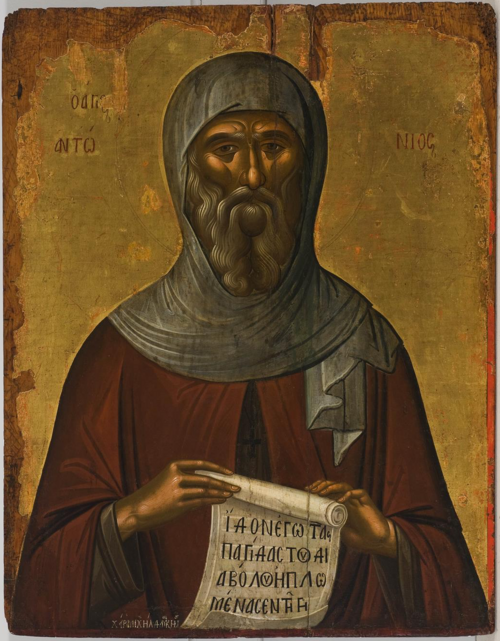
Saint Anthony of Egypt
Abbot
- Feast Day
- January 17
- Life
- 251–356
- Order
- Father of Christian monasticism
- Born
- Coma (Qiman al-Arus), Egypt
Anthony was born about 251 in Coma in middle Egypt to Christian Coptic parents. According to Athanasius's Life of Anthony (Vita Antonii), written shortly after the saint's death, his parents died when he was about eighteen, leaving him a substantial inheritance. Hearing the Gospel passage "If you wish to be perfect, go, sell your possessions and give to the poor" (Matthew 19:21) read in church, he sold his property, provided for his sister, and entered upon the ascetic life.
For about fifteen years he lived as a hermit near his village under the guidance of an older ascetic. Around 285 he withdrew to an abandoned fort at Pispir on the east bank of the Nile, where he remained twenty years in solitary prayer and combat with demons, episodes vividly described by Athanasius. About 305, drawn by disciples, he emerged to organize a colony of hermits, the first form of Christian monasticism.
During the Diocletianic persecution he traveled to Alexandria to encourage confessors. Later he withdrew further into the desert to a mountain near the Red Sea (Mount Colzim), where his monastery still stands. He emerged again about 338 to support Athanasius against the Arians.
Anthony died on Mount Colzim on January 17, 356, said by Athanasius to be in his hundred-and-fifth year. The Greek Vita Antonii was translated into Latin by Evagrius of Antioch and circulated through the West, where Augustine in his Confessions records its decisive role in his own conversion (Confessions VIII, 6). Anthony is honored as the Father of Christian monasticism.
The Life of Anthony shaped the Christian imagination of holiness for the patristic and medieval West and East alike. Anthony's withdrawal to the desert was not flight from the Church but a public sign of the absoluteness of the Gospel call. His combat with the demons taught later monastics to read the spiritual life as warfare; his counsels, preserved in the Apophthegmata Patrum, founded the genre of monastic wisdom literature.
Patronages
monks · skin diseases · domestic animals · butchers
Catholic Churches Named After Saint Anthony of Egypt
20 parishes on Catholic Church Times share Saint Anthony of Egypt's name. Find their Mass times, confession schedules, and adoration hours:
- St. Anthony — Northvale, NJ
- St. Anthony of Padua — Cambridge, MA
- St. Anthony of Padua — Lowell, MA
- SS Anthony & Philip Parish — Highland, WI
- St. Anthony's Catholic Church — Oakley, CA
- St.Anthony — Wuppertal, DELAWARE
- St. Anthony of Egypt Mission — Farmersville, CA
- St. Anthony Mission Chapel — Cade, LA
- St. Anthony-St. Faustina Parish — Forestville, PA
- St. Mary of Perpetual Help and All Saints-St. Anthony Parish — Chicago, IL
- St. Anthony of Padua Church — Atlanta, GA
- St. Mary and St. Anthony — Kansas City, KS
- Saint Mary of Perpetual Help, All Saints and St. Anthony Parish — Chicago, IL
- St. Anthony — Cody, WY
- St. Anthony — Newport, WA
- St. Anthony Catholic Church — Plevna, MT
- St. Anthony — Guernsey, WY
- St. Anthony Catholic Church — Lakeland, FL
- St. Anthony St George Catholic Church — Wilkes-Barre, PA
- St. Anthony — El Segundo, CA
Sources