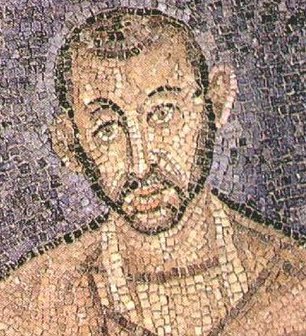
Saint Ambrose
Bishop and Doctor of the Church
- Feast Day
- December 7
- Life
- 340–397
- Doctor of the Church
- 1298
- Born
- Trier, Gaul (modern Germany)
Ambrose was born around 340 at Trier (Augusta Treverorum), where his father served as Praetorian Prefect of the Gauls. After his father's early death the family returned to Rome, where Ambrose was educated in classics and law and entered imperial service. By 372 he was governor (consularis) of Aemilia-Liguria, with his seat at Milan, then the residence of the Western emperors. In 374, when the Arian bishop of Milan died and Catholics and Arians clashed in the cathedral over the succession, Ambrose - still only a catechumen - went to keep order; the crowd unexpectedly acclaimed him bishop. Within a week he was baptized, ordained successively to each lower order, and consecrated bishop on December 7, 374.
As bishop he led the Catholic resistance to Arianism in the West, refused to surrender a Milanese basilica to the Arian Empress Justina (385-386), and after the massacre at Thessalonica in 390 imposed public penance on the Emperor Theodosius I before readmitting him to communion - an unprecedented assertion that the Catholic Bishop has authority over the moral conscience of the Christian emperor. He composed Latin hymns of such power that the form is still called Ambrosian; he developed the Latin liturgy of his diocese (the Ambrosian Rite) which Milan retains to this day; and he wrote extensively on Scripture, the sacraments (his De Sacramentis is the earliest detailed Latin description of baptismal initiation), virginity, and Christian ethics. His preaching converted the young rhetorician Augustine of Hippo, whom he baptized at the Easter Vigil in 387. Ambrose died at Milan on Holy Saturday, April 4, 397; his feast is kept on the date of his episcopal consecration, December 7. Pope Boniface VIII proclaimed him a Doctor of the Church in 1298.
Ambrose is one of the four great Latin Doctors (with Augustine, Jerome, and Gregory the Great), and the doctor par excellence of the Church's relationship to the state: a bishop is no mere religious official of the empire but the conscience of even the emperor. He is also the doctor of liturgy and Scripture as means of catechesis, and the master of Augustine.
Patronages
beekeepers · candle-makers · the city of Milan · learning
From Saint Ambrose
"The emperor is within the Church, not above the Church."
Catholic Churches Named After Saint Ambrose
20 parishes on Catholic Church Times share Saint Ambrose's name. Find their Mass times, confession schedules, and adoration hours:
- Peace of Christ Parish - St. Ambrose — Rochester, NY
- St. Ambrose — Dorchester, MA
- St. Ambrose — Buffalo, NY
- St. Ambrose Roman Catholic Church — Sidney, NY
- St. Ambrose Catholic Church — Saint Louis, MO
- St. Ambrose Catholic Church — Cecilia, KY
- St. Ambrose Church — Seymour, IN
- St. Ambrose — Berkeley, CA
- St. Ambrose — Tucson, AZ
- St. Ambrose — Albion, RI
- St. Ambrose — Delton, MI
- St. Ambrose Catholic Community — Woodbury, MN
- St. Ambrose — Edavanakkad, Kerala
- St. Ambrose Catholic Church — Cheverly, MD
- St. Ambrose — Erie, KS
- St. Ambrose — Parchment, MI
- St. Ambrose — Grosse Pointe Park, MI
- St. Ambrose Catholic Church — Deadwood, SD
- Christ the King Chapel (St. Ambrose University) — Davenport, IA
- St. Ambrose — Old Bridge, NJ
Sources