Palm Sunday of the Passion of the Lord
Solemnity
- Feast Day
- March 29
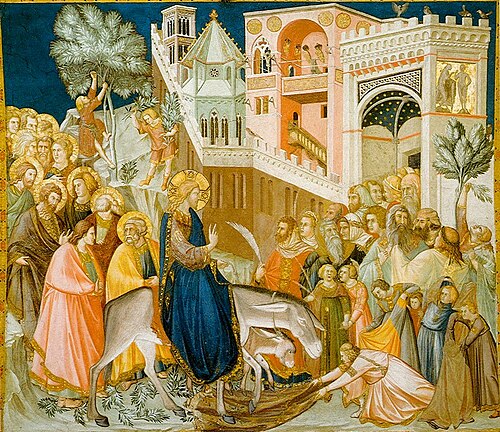
Palm Sunday of the Passion of the Lord opens Holy Week. The liturgy unites two scenes: the triumphal entry of Christ into Jerusalem, recorded in all four Gospels (Matthew 21:1-11, Mark 11:1-10, Luke 19:28-40, John 12:12-19), and the proclamation of the Passion narrative, read in 2026 from the Gospel according to Matthew (Year A of the Sunday Lectionary cycle).
The day's liturgy begins with the blessing of palms and a procession or solemn entrance recalling Christ's entry into the Holy City. The faithful carry palms or olive branches as the people of Jerusalem did, hailing him as the Son of David. The Mass that follows then turns immediately to the Passion, foretelling the events of the Sacred Triduum.
The procession is attested in Jerusalem by the late fourth century in the Itinerarium of Egeria, who describes the bishop and people walking from the Mount of Olives down into the city carrying palm and olive branches. The Roman tradition adopted the rite by the eighth century, and the present form is governed by the General Norms for the Liturgical Year and the Calendar (no. 31) and the Roman Missal.
Palm Sunday discloses the paradox of the Paschal Mystery: the King who enters Jerusalem on a donkey to the cries of Hosanna is the same who will be crucified outside the city walls within the week. Pope Benedict XVI in his 2007 Palm Sunday homily described the procession as our acclamation of Christ as our King and our entry with him into the mystery of his Passion. The liturgy gives the faithful the words of both the welcoming crowd and, in the Passion, of those who would later cry Crucify him, summoning each to recognize the depth of human inconstancy and the steadfastness of divine love.
Sources