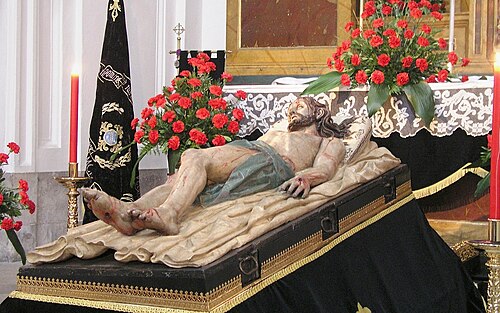
Holy Saturday
- Feast Day
- April 4
Holy Saturday is the day on which the Church keeps watch at the Lord's tomb, meditating on his Passion and Death and on his descent to the dead, professed in the Apostles' Creed. No Mass is celebrated and the sacraments, with the exception of Penance and the Anointing of the Sick (the latter only as Viaticum), are not administered.
After nightfall, the Church celebrates the Easter Vigil, called by Saint Augustine the mother of all vigils and described in the Roman Missal as the greatest and most noble of all solemnities. The Vigil has four parts: the Solemnity of Light, including the blessing of the new fire, the lighting of the Paschal candle, and the singing of the Exsultet; the Liturgy of the Word, with up to seven readings from the Old Testament tracing salvation history, followed by the Epistle and Gospel of the Resurrection; the Baptismal Liturgy, in which catechumens are baptized and confirmed and the faithful renew their baptismal promises; and the Liturgy of the Eucharist, the first Mass of Easter.
The Vigil must begin after nightfall and end before daybreak (Roman Missal, rubric for Holy Saturday). It is the principal moment for the celebration of Christian initiation in the Roman Rite.
Holy Saturday is a day of silence between Cross and Resurrection. In his 2007 Holy Saturday homily, Pope Benedict XVI described it as the day of the hiddenness of God, the day on which we wait. The Easter Vigil that follows is the liturgical center of the entire year. The Catechism of the Catholic Church (1169) calls Easter the Feast of feasts, and the Vigil the heart of all Christian liturgy. In the lighting of the Paschal candle and the proclamation of the Exsultet, the Church proclaims that Christ has conquered death, and in the Baptismal Liturgy she gives birth to new children of God.
Sources