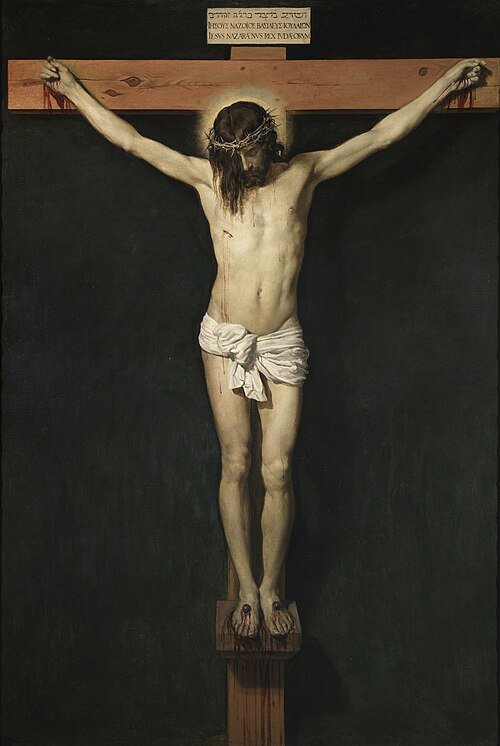
Good Friday
Friday of the Passion of the Lord
- Feast Day
- April 3
Good Friday, Friday of the Passion of the Lord, commemorates the crucifixion and death of Jesus Christ. It is, with Ash Wednesday, one of two universal days of fasting and abstinence in the Latin Church, binding all the faithful from age fourteen (abstinence) and between eighteen and the beginning of their sixtieth year (fasting), per the 1983 Code of Canon Law (cc. 1251-1252).
No Mass is celebrated on Good Friday or Holy Saturday. The Roman Missal provides the Celebration of the Lord's Passion, ordinarily held in mid-afternoon. The rite has three parts: the Liturgy of the Word, including the proclamation of the Passion according to John (John 18:1-19:42) and the Solemn Intercessions, ten in number, for the Church and the world; the Adoration of the Holy Cross, in which a single cross is solemnly unveiled and venerated by the faithful; and Holy Communion from hosts consecrated at the previous evening's Mass of the Lord's Supper.
The Church's tradition reserves the celebration of the Eucharist on this day in honor of the unique sacrifice of the Cross. The bare altar, the silent entrance of the priest who prostrates himself before the altar, and the absence of the customary greetings express the Church's grief at the death of her Lord.
Good Friday is the day on which the Church contemplates the death of Christ for the salvation of the world. In Ecclesia de Eucharistia 11, Pope Saint John Paul II teaches that the sacrifice of the Cross, made present in every Mass, has its historical reality on this day. The Solemn Intercessions, retained in their ancient Roman form, express the Church's universal prayer for all peoples, including, since the revisions of the Second Vatican Council and Pope Benedict XVI, a prayer for the Jewish people that respects God's irrevocable covenant with them.
Sources