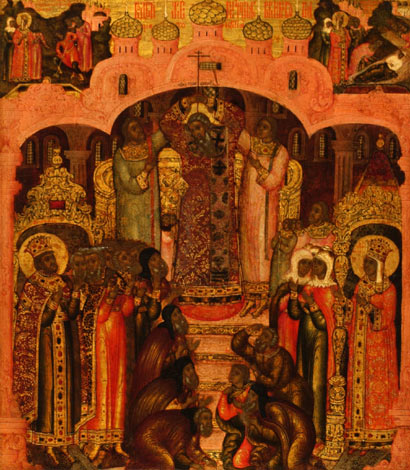
The Exaltation of the Holy Cross
Feast
- Feast Day
- September 14
The Feast of the Exaltation of the Holy Cross celebrates two events. The first is the discovery of the True Cross at Jerusalem about 326 by Saint Helena, mother of the Emperor Constantine, during the construction of the Constantinian basilica complex on Calvary. The second is the dedication on 13 September 335 of the basilicas of the Anastasis (Resurrection) and Martyrium (Calvary), erected on the sites of Christ's crucifixion and Resurrection. On the day after the dedication, the relic of the Cross was lifted up before the people for veneration.
A further event memorialized in the East is the recovery of the relic of the Cross by the Emperor Heraclius in 629, after its capture by the Persian king Chosroes in 614. Heraclius is said to have restored the relic to Jerusalem on 14 September. The feast spread to Rome in the seventh century, where the basilica of Santa Croce in Gerusalemme houses fragments of the True Cross brought back by Saint Helena.
The liturgy of the day proclaims the paradox of the Cross: the instrument of an ignominious execution becomes the throne of the King of glory and the tree of salvation. The reading from Philippians 2:6-11 sings of Christ's self-emptying, and the Gospel (John 3:13-17) recalls Christ's words to Nicodemus: Just as Moses lifted up the serpent in the desert, so must the Son of Man be lifted up.
The Exaltation of the Cross is celebrated as a Feast on the General Roman Calendar with red vestments. The day's liturgy enshrines the central paradox of the Christian faith: that through suffering willingly accepted in love, death is overthrown and life given to the world. The feast frames the next day's Memorial of Our Lady of Sorrows, who stood at the foot of the Cross.
From The Exaltation of the Holy Cross
"We adore you, O Christ, and we praise you, because by your Holy Cross you have redeemed the world."
Sources