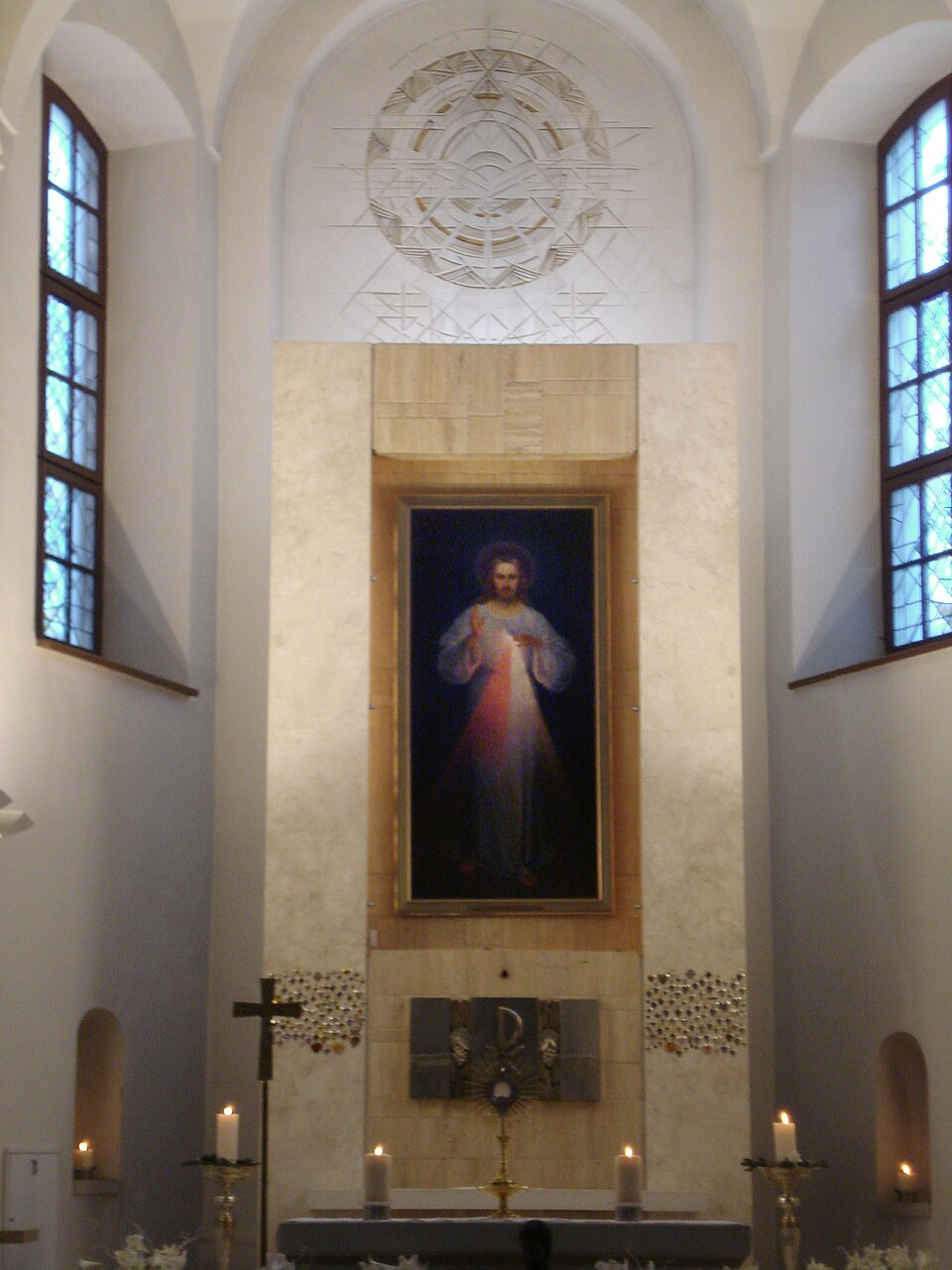
Divine Mercy Sunday
Second Sunday of Easter
- Feast Day
- April 12
The Second Sunday of Easter, the Octave Day of Easter, was designated by Pope Saint John Paul II as the Sunday of Divine Mercy at the canonization of Saint Maria Faustina Kowalska on April 30, 2000. In his canonization homily he declared: it is important then that we accept the whole message that comes to us from the word of God on this Second Sunday of Easter, which from now on throughout the Church will be called Divine Mercy Sunday.
The decree was formalized by the Congregation for Divine Worship on May 5, 2000, and an indulgence attached to the day was granted on June 29, 2002. The Gospel of the day is John 20:19-31, the appearance of the risen Christ to the apostles in the Upper Room on the evening of Easter Sunday and again eight days later, when he invites Thomas to touch the wounds of the Passion. In the first appearance Christ breathes on the apostles, gives them the Holy Spirit, and confers on them the power to forgive sins, instituting the Sacrament of Penance.
The Diary of Saint Faustina records the revelations she received from 1931 to 1938 in Plock, Vilnius, and Krakow, including the image of the Merciful Christ with the inscription Jesu, ufam Tobie (Jesus, I trust in You) and the Chaplet of Divine Mercy. The Vatican lifted the prior restriction on her writings in 1978 and her cause for beatification was opened by Pope Saint John Paul II, who beatified her in 1993 and canonized her in 2000.
Divine Mercy Sunday gives liturgical expression to the doctrine that mercy is the principal attribute by which God's love reaches the sinner. In the encyclical Dives in Misericordia (1980), Pope Saint John Paul II had already developed at length the theology of divine mercy as the meaning of the Paschal Mystery. The placing of this celebration on the Octave Day of Easter unites the institution of the Sacrament of Penance, recorded in the day's Gospel, with the Resurrection itself, teaching that the Risen Christ comes precisely as the source of mercy for the wounded.
Sources