The Most Holy Body and Blood of Christ (Corpus Christi)
Solemnity
- Feast Day
- June 7
The Solemnity of the Most Holy Body and Blood of Christ, traditionally Corpus Christi, celebrates the Real Presence of Jesus Christ in the Most Blessed Sacrament of the Eucharist. In 2026, in the United States, it is observed on Sunday, June 7, the Sunday after Trinity Sunday, in accord with the decision of the U.S. Bishops to transfer the Solemnity from its proper Thursday.
The feast originated in the diocese of Liege in 1246 through the visions and labors of Saint Juliana of Cornillon, an Augustinian nun. After examining miracles attributed to the Eucharist, especially the Eucharistic miracle of Bolsena (1263), Pope Urban IV extended Corpus Christi to the universal Church by the Bull Transiturus de hoc mundo on August 11, 1264. He commissioned Saint Thomas Aquinas to compose the proper texts for the Mass and Office, including the hymns Pange Lingua, Sacris Solemniis, Verbum Supernum, and the sequence Lauda Sion.
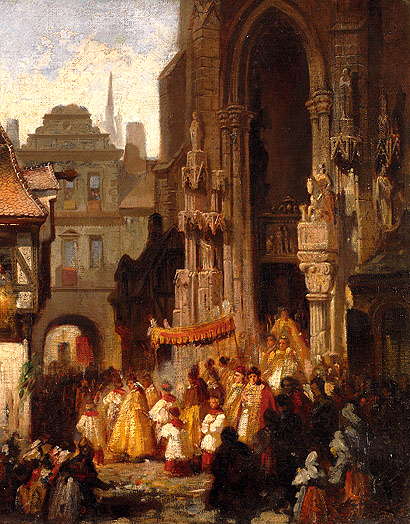
The procession of the Most Blessed Sacrament, traditionally held after the principal Mass, became a hallmark of the feast from the fourteenth century. It was promoted by Pope Saint John Paul II as a public profession of Eucharistic faith and by Pope Benedict XVI in his apostolic exhortation Sacramentum Caritatis (2007).
Corpus Christi is the public, festive thanksgiving for the gift of the Eucharist whose institution the Church remembers in the more somber liturgy of Holy Thursday. The Sequence Lauda Sion compresses the entire Catholic doctrine of the Eucharist into rhymed verse, including transubstantiation (Council of Trent, Session 13), the lasting Real Presence under both species, and reception by the worthy and unworthy alike. The Catechism teaches that the Eucharist is the source and summit of the Christian life (Lumen Gentium 11; CCC 1324).
Sources