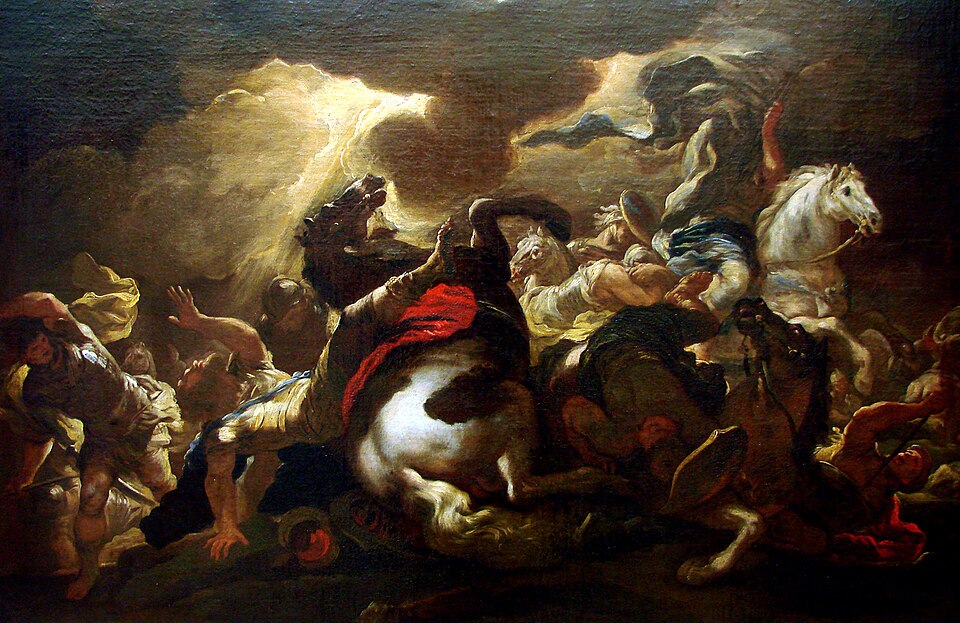
The Conversion of Saint Paul, Apostle
Feast
- Feast Day
- January 25
The Feast of the Conversion of Saint Paul on January 25 commemorates the event recorded in Acts 9:1-19 (and rehearsed by Paul himself in Acts 22:6-21 and 26:12-18, and in Galatians 1:13-17): Saul of Tarsus, a Pharisee zealous for the Law and a persecutor of the Church, was journeying to Damascus with letters from the high priest authorizing him to arrest Christians, when a light from heaven flashed around him, he fell to the ground, and he heard the voice of the risen Lord: "Saul, Saul, why are you persecuting me?" (Acts 9:4).
Blinded for three days, he was led into Damascus, where the disciple Ananias, sent by the Lord, baptized him. From that moment Saul, henceforth named Paul, became the apostle to the Gentiles, the architect of the Church's mission beyond Israel, and the writer of thirteen letters in the New Testament canon.
The feast emerged in the Gallican rite by the eighth century and entered the Roman calendar by the eleventh. It marks the closing day of the Week of Prayer for Christian Unity, which begins on January 18 (the older feast of the Chair of Saint Peter at Rome) and ends on January 25, an arrangement proposed in 1908 by the Anglican Father Paul Wattson, later received by the Roman Catholic Church and now observed ecumenically.
In 2026 January 25 is the Third Sunday in Ordinary Time; the Feast of the Conversion of Saint Paul yields to the Sunday and is not observed liturgically that year. The Sunday is also the Sunday of the Word of God, instituted by Pope Francis in the Apostolic Letter Aperuit illis (September 30, 2019).
The conversion of Paul stands in the New Testament not only as a personal narrative but as a paradigm of grace: the persecutor is made apostle by direct intervention of the risen Lord. The placement of his feast at the close of the octave of Christian unity reflects the Church's belief that the unity of the disciples comes only from the Christ who appeared to Saul on the road. The Sunday of the Word of God, on which the feast falls in 2026, holds before the faithful the Scriptures that Paul both received and wrote.
Sources