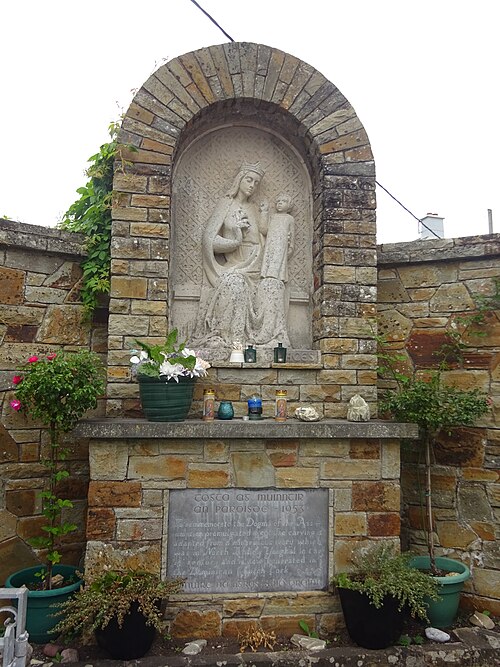
The Assumption of the Blessed Virgin Mary
Solemnity
- Feast Day
- August 15
The Solemnity of the Assumption of the Blessed Virgin Mary celebrates the dogma, defined by Pope Pius XII in the Apostolic Constitution Munificentissimus Deus on November 1, 1950, that the Immaculate Mother of God, the ever-Virgin Mary, having completed the course of her earthly life, was assumed body and soul into heavenly glory. The dogma is a defined truth of Catholic faith, and the proximate definition reads: We pronounce, declare, and define it to be a divinely revealed dogma that the Immaculate Mother of God, the ever-Virgin Mary, having completed the course of her earthly life, was assumed body and soul into heavenly glory (Munificentissimus Deus 44).
The feast itself is among the oldest of Marian celebrations. The fifth-century Eastern liturgy already kept on August 15 a feast called the Dormition (the Falling-Asleep) of the Mother of God; the Emperor Maurice (582-602) extended its observance throughout the Byzantine Empire. In the West the feast spread from the seventh century, originally also under the title Dormition, then increasingly the Assumption. By the time of Saint John of Damascus (d. 749) the substance of the doctrine, that Mary was bodily taken up into heaven at her dormition, was firmly held in both East and West.
The dogma rests, in the words of Pius XII, on the universal and constant ordinary magisterium of the Church, on the saints and Doctors who have unanimously held it (Saints Andrew of Crete, John Damascene, Anthony of Padua, Albert the Great, Bonaventure, Thomas Aquinas, and many others), and on the convergent witness of the sacred liturgy of East and West. Munificentissimus Deus, the only definition of a dogma issued by the extraordinary papal magisterium since Pope Pius IX's Ineffabilis Deus (1854) on the Immaculate Conception, came after Pope Pius XII consulted the world's Catholic bishops in 1946 (Deiparae Virginis Mariae); their virtually unanimous response confirmed the universal episcopal teaching.
In the United States, the Assumption is normally a Holyday of Obligation. By Decree of the Sacred Congregation for the Clergy on December 13, 1991, when the Solemnity falls on a Saturday or a Monday, the obligation to attend Mass is abrogated (USCCB Liturgical Calendar 2026, Note 6c). In 2026 August 15 falls on a Saturday, so the obligation does not bind the faithful in the United States.
The Assumption is the eschatological fulfillment in the Mother of the dogma of the Resurrection of the Body and the central Catholic claim that grace heals nature. Pope Pius XII teaches in Munificentissimus Deus that the Assumption is intimately bound to the Immaculate Conception (Mary's freedom from original sin) and to her divine maternity (defined at Ephesus, 431). The Catechism reaffirms that Mary's Assumption is a singular participation in her Son's Resurrection and an anticipation of the resurrection of other Christians (CCC 966). The Solemnity is observed throughout the Catholic world in white, with proper Office, Mass, and (in the Latin Rite) the Vigil Mass on the evening of August 14.
Patronages
France (national patroness, by vow of Louis XIII, 1638) · Paraguay · Malta · the Marian Year
Catholic Churches Named After The Assumption of the Blessed Virgin Mary
20 parishes on Catholic Church Times share The Assumption of the Blessed Virgin Mary's name. Find their Mass times, confession schedules, and adoration hours:
- St. Mary of the Assumption- Our Lady of Perpetual Help Parish — Glenshaw, PA
- Our Lady of the Assumption — Albuquerque, NM
- St. Mary of the Assumption Church — Cheshire, MA
- Our Lady of the Assumption — Bloomingburg, NY
- St. Mary of the Assumption — San Jose, CA
- Our Lady of the Assumption Catholic Church — Walton, KY
- Chapel of Our Lady of the Assumption - St. Edmunds Retreat — Mystic, CT
- Our Lady of the Assumption Mission — Zia Pueblo, NM
- Our Lady of the Assumption — Harlingen, TX
- St. Mary of the Assumption — Elizabeth, NJ
- Church of the Assumption — Gabriels, NY
- Our Lady of the Assumption — Boston, MA
- St. Mary of the Assumption Catholic Church — Laurin, MT
- St. Mary of the Assumption Parish — Chestnut Hill, MA
- St. Mary of the Assumption Catholic Church — Philadelphia, PA
- Saint Mary of the Assumption Catholic Church — West, TX
- Saint Mary of the Assumption Catholic Church — String Prairie, TX
- Our Lady of the Assumption Catholic Church — Turlock, CA
- Cathedral of Saint Mary of the Assumption — Trenton, NJ
- St. Mary of the Assumption — Baldwinsville, NY
Sources